make preferable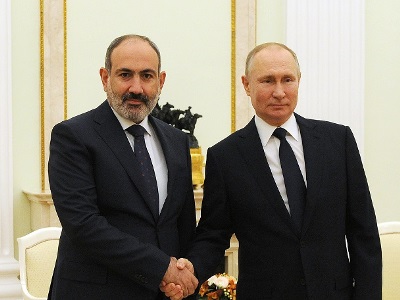
The telephone conversation with Russian President Vladimir Putin was not only about this [i.e. the draft law on Armenia's accession to the EU], but also concerned current affairs within the EAEU and bilateral relations. Armenian Prime Minister Nikol Pashinyan stated this during his press conference Friday.
“This fits into the logic of our bilateral relations and relations within EAEU [i.e. the Eurasian Economic Union]. More than 50 thousand citizens of Armenia have collected signatures and addressed a question to the parliament and the government of Armenia, which corresponds to the statements of the government of Armenia.
Why has such a perception been formed among the citizens of Armenia? This question is related to the agenda of Armenian-Russian relations, and our conversation has been and continues to be about this.
As for Russia's position, Russia has certain concerns, but our conversations have never been and will not be in the language of threats.
Russia has certain concerns, and this is obvious. We [i.e. Armenia] also have certain concerns regarding Russia's position and policy; this is also a fact. But we continue and will continue the dialogue with Russia; and that is also a fact. We will continue to deepen relations with the EU; and that is also a fact.
As for the EAEU, we must be careful not to take steps within the union that would call into question the very content of the EAEU.
Steps have already been taken that have called into question the viability of the CSTO [i.e. the Collective Security Treaty Organization]. This led to the decision to freeze our participation in the organization. That is, not everything is one-sided, all issues have different aspects, and we are doing and will do everything to ensure partnership relations.
No one can and should not deny the right of choice of the citizens of Armenia.
Are there no problems in these relations? There are problems. Maybe we are misunderstanding something. Citizens have the right to ask, ‘Can Armenia follow the path of EU membership?’ Yes, they do,” Pashinyan noted.
He added that the November 9, 2020 trilateral statement already contains irreversible points: for example, there are no longer any Russian peacekeepers in Nagorno-Karabakh.
“The problem started with the fact that some people tried to interpret this point [i.e. point 9 in the aforesaid statement] as limiting Armenia’s sovereignty. But that’s not how it’s written. We said that there is no such issue, there can’t be,” the Armenian PM concluded.