make preferable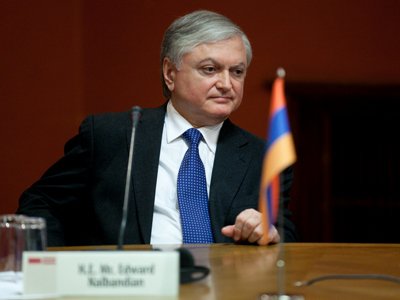
The international community needs to take more tangible steps in order to curb Baku’s provocative and destructive policy.
Foreign Minister Edward Nalbandian on Wednesday stated the aforesaid during his lecture on Armenia’s foreign policy, and which he delivered before diplomats, analysts, and journalists in Rome.
“Nagorno-Karabakh [has] has never been part of independent Azerbaijan,” Nalbandian stated in connection with the Karabakh conflict. “I would like to refer to an interesting document sent to Italian Foreign Minister Sforza by his diplomatic envoy Mr. Gorrini in December 1920, where he clearly states that Nagorno-Karabakh is a part of the Republic of Armenia. This is only one evidence among many in this regard. However, in 1921 by the unilateral decision of Josef Stalin Nagorno-Karabakh was forcefully annexed to administrative rule of Soviet Azerbaijan as an autonomous region, while its population was 90% Armenian. In 1988 the Armenians of Nagorno-Karabakh which comprised by the time more than 75% of the population started a peaceful movement for self-determination. In 1991 Nagorno-Karabakh through referendum declared its independence. In 1999 the European Parliament through a special resolution confirmed that Nagorno-Karabakh declared its independence in a same manner as other former Soviet Republics.
“Azerbaijan responded with massacres, ethnic cleansing and deportation of around 400.000 Armenians. A full-scale war broke out and its hot phase ended in May 1994 when Nagorno-Karabakh, Azerbaijan and Armenia signed a trilateral cease-fire agreement without time limitations.
“Azerbaijan over the years has continuously violated the ceasefire and in April 2016 unleashed a four day large-scale aggression against Nagorno-Karabakh. It was accompanied by gross violations of the international humanitarian law, including Daesh style beheadings and other atrocities, in an apparent attempt to terrorize the people of Nagorno-Karabakh. The four-day military offensive in April was the culmination of the policy pursued by Baku during recent years but was not its end. It is obvious that through escalating the situation in the Nagorno-Karabakh conflict zone Azerbaijan tries to shift the public attention from ongoing economic and social difficulties, gross human rights violations and public outrage in Azerbaijan.
“Since 1997 the conflict resolution has been mediated by three Co-Chairs of the Minsk Group of the Organization for Security and Cooperation in Europe – Russia, France and the United States. Several times the settlement was close, however, Azerbaijan made steps back at the last moment, most notably in Key West (USA) in 2001 and in Kazan (Russia) in 2011.
“During the last years the negotiations are held on the Basic Principles of the Nagorno-Karabakh conflict resolution, the so called Madrid Principles, proposed by OSCE Minsk Group Co-Chair countries. The Presidents of the Co-Chair countries issued five statements outlining that the settlement should be based on three core principles of international law – non use of force or threat of use of force, territorial integrity, equal rights and self-determination of people. They also stated that the future legal status of Nagorno-Karabakh should be determined by legally binding free expression of will of its population.
“According to its longstanding position the European Union supports the efforts of the Co-Chairs, including the statements of the Presidents of the Co-Chair countries, that was once again reiterated in the EU Eastern Partnership Summit Declaration adopted in Riga.
“The Co-Chairs proposed the civilized way of solving the issue through mutual compromises. However, Azerbaijan, here again has adopted a maximalist, uncompromising stance in an “either our way or no way” manner and openly threatens with new hostilities taking the negotiation process as a hostage, blackmailing and continuing constant profanation of the Co-Chairs.
“Azerbaijan does everything to derail the agreements reached on the level of presidents on the expansion of the team of the personal representative of the OSCE Chairman-in-Office, which is currently the only international presence on the ground in the conflict zone, as well as creation of the mechanism for investigation of the ceasefire violations. Apparently, Azerbaijan wants to keep its hands free from the international scrutiny over its continuous non-compliance. However, even in the absence of the strong monitoring mechanisms it is clear who stands behind the breaches and the Co-Chairs have named Azerbaijan as the initiator of the ceasefire violations.
“Given the defiant attitude of Azerbaijan towards international efforts a time has come for the international community for more tangible steps in order to curb Baku’s’ provocative and destructive policy.
“There is no alternative to the negotiations and Armenia will continue its efforts together with the Co-Chairs aimed at exclusively peaceful resolution of the conflict.”