make preferable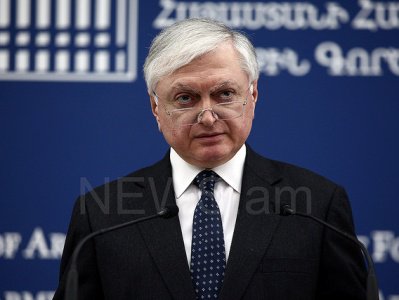
On the sidelines of his working visit to Rome, Foreign Minister of Armenia Edward Nalbandian on Thursday visited the Italian Society for International Organization operating under the supervision of the Ministry of Foreign Affairs and International Cooperation of Italy.
There Edward Nalbandian delivered a comprehensive lecture on Armenia’s foreign policy. The event was attended by the research center fellows, diplomats accredited in Rome, analysts and journalists, the press service of the Armenian MFA informed Armenian News – NEWS.am.
Before the lecture, FM Nalbandian met with Franco Frattini, President of the Italian Society for International Organization and former Minister of Foreign Affairs of Italy. The sides discussed steps being undertaken for the developing the Armenian-Italian relations, as well as urgent regional and international issues.
In his speech, Nalbandian noted, in particular:
“I would like to thank the Italian Society for International Organization and its president, my good old friend Franco Frattini, for organizing this meeting. I greatly appreciate the opportunities of exchanges within the academic circles and expert communities, which allow to not only present our thoughts and views, but also listen and comprehend. Therefore, I will start with a short introduction and then will encourage a Q&A session, in a more interactive manner.
The current warm ties between Armenia and Italy have deep historical roots that go all the way back to the Roman Empire. They especially strengthened after Armenia and then Rome adopted Christianity as a state religion. Last year His Holiness Pope Francis visited Armenia “as a pilgrim to the first among the Nations to receive the Gospel of Jesus”.
The Armenian Italian ties flourished in the Middle Ages, during active political and economic interactions between Cilician Armenian Kingdom and Genoa, Venice and Pisa. As an echo of those centuries-old close ties, the Italian House of Savoy retained the title “King of Armenia” till the modern times. Armenian Congregation of Mekhitarists–established on the island of San Lazzaro in Venice in 1717–has long been regarded as one of the Armenian cultural centers. The first ever Armenian published book was printed in Italy in 1512. There are a lot of historic facts testifying to the close ties between our nations. I simply mentioned a few to give an overall idea. In modern times too, there were various Armenians, who were well known and played prominent roles in the Italian society.
The Armenian Italian relations gained new momentum after the independence of Armenia. This year marks the 25th anniversary of the establishment of diplomatic relations between our countries. During the past quarter of a century we have managed to forge strong partnership in wide array of fields ranging from the high level political dialogue to the economic cooperation, partnership in cultural, academic and many other fields. We have also formed a pretty comprehensive legal framework which comprises over thirty legal documents.
Armenia and Italy are jointly investing their efforts for the peace and security in the United Nations Interim Force in Lebanon (UNIFIL), as well as in the Resolute Support Mission in Afghanistan. As nations with rich cultural and historical heritage, we successfully cooperate in the field of preservation of historical and cultural heritage.
Armenia is very much interested in further strengthening and deepening its ties with Italy. I am in Rome to attend the first session of the Armenian-Italian Intergovernmental Commission. During the visit of His Excellency Paolo Gentiloni to Armenia last year in his capacity as a foreign minister, we together agreed on establishing this important format to boost our economic relations. It was followed by a business forum. In the course of this visit, I also had a bilateral meeting with my colleague, Minister Alfano, Secretary for Relations with States of Holy See Gallagher, as well as members of the Italian Parliament.
The cooperation between Armenia and Italy goes beyond the bilateral framework and encompasses also the multilateral track, most notably the Eastern Partnership and European Neighborhood Policies of the European Union. We expect to sign the Comprehensive and Enhanced Partnership Agreement between Armenia and the European Union at the EU Eastern Partnership Summit to be held in Brussels this fall, which defines the framework for active political dialogue, cooperation in many areas, dynamic trade and economic relations, and expanded sectoral cooperation. Once it is signed, Armenia—as a member of the Eurasian Economic Union encompassing 180 million strong markets—can further contribute both as a bridge in utilizing the available opportunities, providing its services and investment tools and as a platform for commercial transactions between EAEU and EU member states, particularly, Italy.
We are also looking forward to Italy’s upcoming Chairmanship in one of the most important regional Organizations – the OSCE, which we believe should continue to play a vital role in the current turbulent international affairs.”