make preferable
Azerbaijan attempts to by all means conceal the Sumgait massacre, to avoid responsibility and to shift attention from it through fabricated accusations.
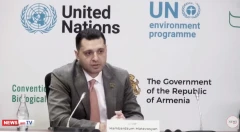
The Foreign Minister of Armenia, Edward Nalbandian, on Tuesday noted the abovementioned in his address at the High Level Segment of the 37th Session of the United Nations Human Rights Council (UNHRC), in Geneva, Switzerland.
“This year we mark the 70th anniversaries of two fundamental documents in the field of human rights protection, namely the Universal Declaration of Human Rights and the Convention on the Prevention and Punishment of the Crime of Genocide,” said the Armenian FM. “The Universal Declaration is widely acknowledged as a milestone document in the history of human rights. Nevertheless, its provisions have not only been continuously ignored, but grossly violated in many parts of the world.
“Thirty years ago, during these very days in February 1988 anti-Armenian pogroms broke out in Azerbaijani Sumgait leaving numerous Armenians killed, maimed and deported. They were perpetrated by the authorities of Azerbaijan with the aim to punish Armenians for the peaceful aspirations of the people of Nagorno-Karabakh for self-determination. Those atrocities were the very reason why Nobel Peace Prize Laureate Andrei Sakharov wrote that ‘even if some doubted it before Sumgait, no one sees a moral opportunity to insist on territorial unity of Nagorno-Karabakh and Azerbaijan after this tragedy happened.’
“The Sumgait massacre was widely condemned by the international community, including by the resolution of the European Parliament. Regrettably, the masterminds and perpetrators of this crime were not duly punished. As it happened many times in the human history, impunity opened the door for new atrocities, including Armenian massacres and ethnic cleansing in Baku, Kirovabad (Gandzak), Maragha and many other places.
“By all means Azerbaijan attempts to conceal these atrocities, to avoid responsibility and to shift attention from them through fabricated accusations, including by the so-called Khojaly campaign, trying to portray themselves as victims and discredit Armenians as alleged perpetrators of the violence.
“It is a part of Azerbaijan’s xenophobic anti-Armenian policy. The UN Committee on the Elimination of Racial Discrimination, European Commission Against Racism and Intolerance and many other organizations in charge of human rights expressed concern at constant cases of hate speech in Azerbaijan used against Armenians by political leaders, educational institutions and media and that an entire generation of Azerbaijanis has grown up listening to this hateful rhetoric. It is this kind of anti-Armenian propaganda that has incited continuous atrocities against Armenians, including the gross violations of international humanitarian law committed by the armed forces of Azerbaijan in April 2016 in Nagorno-Karabakh - killing of children, women, elderly people, mutilation of the corpses, beheadings of captured soldiers in the style used by notorious terrorist organizations.”