make preferable
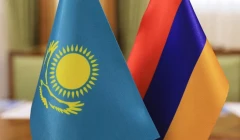
An official with a joint Turkish-Armenian group said ongoing Ankara and Yerevan talks can be called "normalization"—more realistic than “reconciliation” that could be considered too ambitious because the 2009 protocols did not bear fruit, Anadolu Agency reported.
Turkish-Armenian Business Development Council (TABDC) Vice Chairman Noyan Soyak told Anadolu that one of the foremost reasons for Turkey in not establishing direct talks or starting a normalization process with Armenia was due to the Nagorno-Karabakh conflict.
After a cease-fire between Azerbaijan and Armenia was realized through Moscow mediation, it started the process between Turkey and Armenia that was not a much unexpected development, said Soyak.
“South Caucasus is a very important and neighboring geography for Moscow,” Soyak said, referring to the aforesaid conflict.
"Having its regional disputes with Georgia in Caucasus and Ukraine in the southwest—probably Russia wouldn't like to have another continuing conflict in the rest of the South Caucasus, which might have further weakened Russia's influence in the region," he said. “Russia plays a grandiose role in Armenia in many ways.”
“Moreover strategic industries, including defense, energy, railway, and transportation sector, a large part of finance and communication infrastructures in Armenia are under Russian control,” he said.
“Russia's influence over Azerbaijan, although it is not as visible as the case in Armenia, can also not be denied,” according to Soyak.
Russia is the second-largest military supplier to Azerbaijan, he said.
“The biggest military supplier to Azerbaijan is Israel, which gives a glimpse of the idea of Israeli interests in the conflicted region, having a long border to Iran in the south," he said.
According to Soyak, the US has always been in favor of improved relations between Turkey and Armenia, borders opened and diplomatic relations established.
"But when we consider present relations between Turkey and the US, this subject may not be seen as one of the priorities, but maybe a supporting side act," he said.
Also, Soyak expressed a view that the normalization of Armenian-Turkish relations could help reduce tension between Armenia and Azerbaijan in the long run.
“Some senior bureaucrats in Baku privately suggest that Turkish-Armenian normalization [of relations] might even help smooth their own post-war relations with Armenia by showing the benefits of shifting from a war footing to an everyone-wins focus on trade. Therefore, we can easily say that Baku’s approach to the normalization process is diverted 180 degrees,” Noyan Soyak said.