make preferable
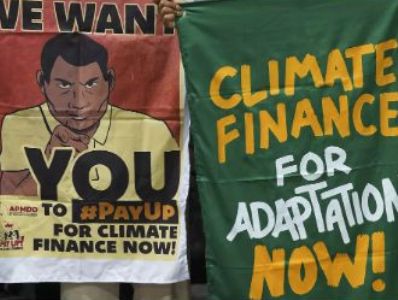
COP29 participants pledged to pay $300 billion a year to help poorer and more vulnerable nations adapt to climate change and shift their economies to green energy by 2035.
Developing countries from India to Cuba, which had demanded more than a trillion dollars in aid, immediately denounced the deal as “insulting.”
The main novelty of the final agreement is that the West intends to ask other major players that are still listed as developing economies, including China and the Gulf states.
While developed countries are indeed called upon to “take the lead” in mobilizing the 300 billion, the text explicitly stipulates that any disbursements by multilateral financial institutions such as the BRICS New Development Bank or the Asian Infrastructure Investment Bank will be taken into account, Euronews reported.
In the final days of the summit, the possibility of a breakdown in the financial negotiations seemed very real.
On Friday (Nov. 22), developing countries rejected as a “joke” a proposal by rich industrialized nations including the EU, the U.S. and Japan for $250 billion a year from 2035.
The revised proposal was later increased to $300 billion, according to civil society observers.
The “least developed countries” group immediately said this was unacceptable, after which the Alliance of Small Island States (AOSIS) joined them and left the negotiating room.
The G77+China group, which includes most of Latin America, Africa and Asia, made it clear that it would accept the $500 billion figure. But that seems to have proved unaffordable for wealthy Western countries.
American climate envoy John Podesta was attacked. Climate activists shouted “shame”, accusing the Biden administration of refusing to “pay the bills”.
“Of course it's not going to be better under Trump, but what they're doing under Biden is really shameful,” said Victor Menotti, director of the International Forum on Globalization, after Podesta was escorted out a side door by security personnel.
“This is not the climate and environmental justice agenda for which he was elected,” Menotti added.
A long period of relative quiet followed, with negotiations taking place behind closed doors.
“We have all worked very hard over the last two weeks and I know that none of us want to leave Baku without a good result,” said COP29 chairman Mukhtar Babayev.
“Time is not on our side,” he told the participants of the two-week summit. - I ask you to intensify the dialog.”
In addition to the crucial financing document, participants also agreed on rules for the creation of a UN-backed global carbon market. It will facilitate carbon trading, incentivizing countries to reduce emissions and invest in climate protection projects.
Location