Preferred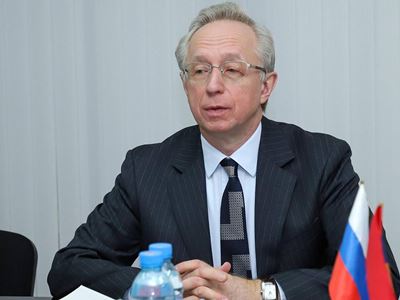
We advocate that the Armenian and Azerbaijani parties, and Armenia and Azerbaijan are countries with which we have allied relations, develop a peace treaty that will pave the way and mean a stable long-term settlement of relations, and will not lay a "landmine" for future generations. This was stated by Russian deputy foreign minister Mikhail Galuzin in an interview with Izvestia.
"Naturally, we [i.e. Russia] are always ready to contribute to progress and are against the signing of any hasty document, as the West claims, which really wants to push Armenia and Azerbaijan to sign a peace treaty as soon as possible on some Western platform. Such hasty, ill-considered, and completely untested decisions may not lead to long-term stable peace, but on the contrary, may sow certain seeds of confrontation for the future, which, of course, we consider extremely undesirable for both Armenia and Azerbaijan, and the South Caucasus and Russia.
Unfortunately, the work of the trilateral group, headed by the deputy prime ministers of Russia, Azerbaijan and Armenia, on the unblocking of [regional] transport communications and the restoration of economic ties has now been interrupted and frozen, so to speak. Of course, we call on the [two] parties and, first of all, our Armenian friends, to return to work within this group. The Russian side is always ready to provide any possible assistance to the parties if they wish,” the Russian diplomat noted.
Galuzin once again stated that Russia considers the West’s policy in the South Caucasus to be absolutely destructive, since it is aimed not at stabilizing the situation in this region of strategic importance for Russia, but at trying to “contribute” to Russia’s strategic defeat from this side.
Sometimes there is even talk of attempts to persuade some countries to open a second front against Russia in the Caucasus, said Galuzin
“As for the strengthening of ties between Armenia on the one hand, the European Union and the entire West on the other, we proceed from the following: Yerevan, the Armenian state, Armenian society, and the Armenian people make sovereign decisions on how to build their foreign policy and how to position their country in the international community. This is their prerogative, and we, as you know, never interfere in the internal affairs of other states and do not impose any ‘recipes’ or our vision on other countries, but try to develop—through dialogue—mutually acceptable ways and compromise approaches to resolving certain issues," the Russian deputy FM noted.