make preferable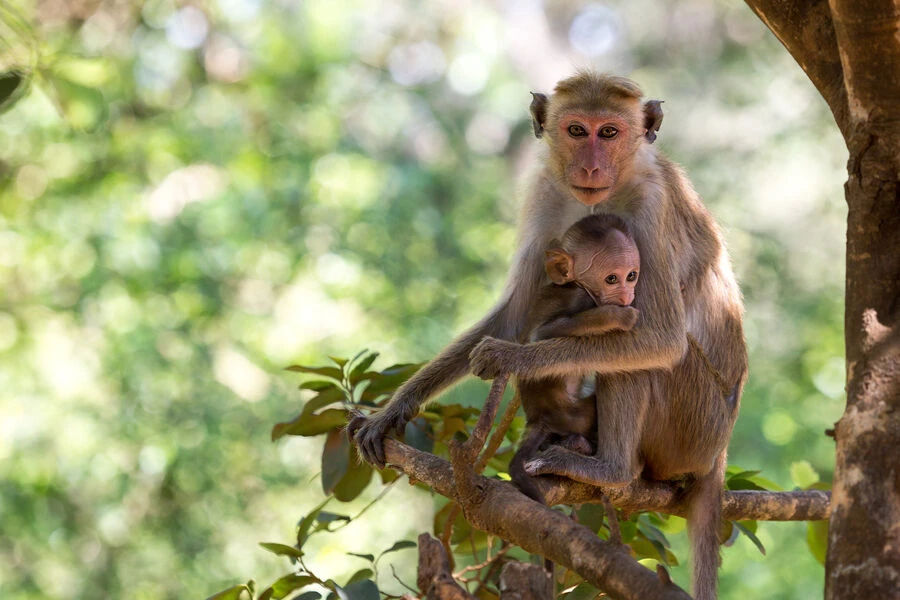
An international team of researchers found that rhesus macaques perform geometric shape recognition tasks at roughly the same level as four- to five-year-old children with no mathematical training. The result suggests that basic geometric thinking does not require instruction — it is built into the brain through evolution. The study was published in the journal PNAS.
The ability to understand geometry is a foundation of mathematics, navigation, and spatial reasoning. For a long time, scientists believed that this ability develops through education and cultural experience. To test this, the researchers turned to creatures that had never attended school.
In the experiments, rhesus macaques were shown sets of geometric figures and asked to pick the odd one out. The tasks involved recognizing angles, symmetry, line parallelism, and basic shapes — triangles, squares, and circles. At the same time, the same tasks were performed by preschool children with no special mathematical training.
The monkeys handled most of the tasks at the level of four- to five-year-old children. At the same time, they performed noticeably worse on tasks requiring abstract geometric concepts — their results were lower than those of older children. This suggests that basic geometric intuitions exist independently of language and culture, while more complex concepts require learning.
Scientists believe that the ability for basic geometric recognition arose in the common ancestor of humans and macaques at least 25 million years ago — as an adaptation for spatial orientation and precise motor control when grasping objects. The results raise a new question: what are the true cognitive “starting conditions” of humans at birth, before any learning begins?