make preferable
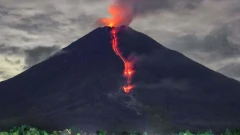
An international research team led by geochemist Dr. Erik Vandenbroucke from the University of Adelaide analyzed ancient rocks in the Pilbara Craton in Western Australia. The scientists found signs that water penetrated deep beneath Earth’s surface and then contributed to the formation of magma from which volcanoes formed, similar to those found today in the Pacific Ring of Fire.
The study’s results, published in Nature Communications, suggest that water cycle processes that shape our planet today were already taking place on Earth, even though conditions during Earth’s early formation were completely different.
The rocks that were found formed more than 3 billion years ago, when Earth was a very different place, according to Nauchnaya Rossiya. Today, water constantly circulates in a process known as plate tectonics. Water from the oceans enters the mantle at subduction zones, where one tectonic plate sinks beneath another, feeding volcanoes that build continents.
Dr. Vandenbroucke from the School of Physics, Chemistry and Earth Sciences said that this research offers a glimpse into Earth’s distant past.
“The early Earth was too hot for tectonic plates to behave in this way, so until now it was unclear whether surface water could have made such a journey more than three billion years ago and, if so, how. We were surprised to find evidence that large amounts of water were already penetrating deep into Earth’s interior and influencing the formation of volcanic rocks,” Vandenbroucke explained.
The new study shows that although modern plate tectonics did not yet exist, water could have entered the mantle through a different process. The researchers propose a mechanism they call “drip subduction.” Under this mechanism, dense, water-rich sections of Earth’s cold outer crust periodically sagged and sank into the hotter mantle, carrying water with them.
As this material descended, the water it contained entered Earth’s mantle, forming magma that fueled volcanic eruptions and then solidified into rocks that can still be studied today.
“Earth did not function exactly as it does now, but it appears that some key processes had already begun,” says Dr. Vandenbroucke.
This discovery helps answer one of geology’s most important questions: when did the exchange of materials between Earth’s surface and interior begin? Understanding when water started penetrating deep underground matters because this process affects everything from volcanic eruptions to continental growth.
The findings provide insight into how Earth’s continents formed and how the planet evolved into the world we know today. Because such ancient rocks are extremely rare, Pilbara—where they are also exceptionally well preserved—is one of the few places where the young Earth can be studied.
By analyzing chemical traces preserved in the rocks, geologists were able to reconstruct events that occurred 3.1 billion years ago.
The results suggest that Earth’s interior and surface may have been connected much earlier than previously thought. This indicates that the young planet was surprisingly dynamic and was already recycling one of its most important components—water.