make preferable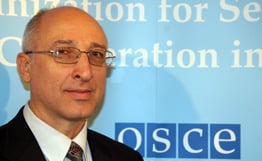
Armenian News-NEWS.am presents an interview with Ambassador Sergey Kapinos, the Head of the OSCE Office in Yerevan.
By Samvel Avagyan
Q.: OSCE in Armenia is seen as a political organization dealing with conflict settlement. However, you often make statements and proposals related to economic or environmental policies. Do such statements make part of the OSCE mission, or do you express your personal opinion?
OSCE is an inclusive international organization. It deals with security problems systematically, dealing with early warning and conflict prevention, as well as crisis management and post-conflict rehabilitation. The OSCE has developed a unique concept of international security in the three “dimensions” – political-military, economic and environmental and human. They are all equal.
Politico-military dimension of the OSCE is considered as classic and is still perceived by the public as a major sphere for the organization’s involvement. However, starting from its existence, the OSCE has also looked at ecology as a key component of security. Transboundary environmental issues comprise one of the probable causes of political tensions and even conflicts between nations. The OSCE also addresses issues that aim at promoting economic cooperation among countries, the formation of “common denominators” of such interaction and dissemination of good practice of economic regulation and management. The OSCE Office in Yerevan, as I have repeatedly noted, is trying to assist the State in carrying out systemic reforms aimed at building new institutions and improvement of existing that stimulate improvement of business climate and entrepreneurship in the country. Robust security is impossible without respect for human rights and fundamental freedoms and the OSCE is working in such areas as fight against human trafficking, elections, human rights, minorities, freedom of the media, etc.
Q.: Experts point out your strong criticism of economic policies in Armenia. Are you really a supporter of revolutionary solutions?
As an economist, I assess – not the economic policies – but the economic model that was formed in Armenia in the 90s and exists up to day. As I’ve mentioned, it has much in common with the classic Latin American system. It is characterized by monopoly and influential informal institutions and only a few countries in the South America opened up and are rapidly evolving - most notably Chile, Peru and Costa Rica. Their experience is highly relevant for states seeking to reform, including Armenia.
I believe that bold and, as you suggested, revolutionary solutions, are necessary but only in cases where the situation demands it. We must not forget that revolutionary decisions move forward science and technical progress. They are able to provide a historical breakthrough.
In general, I am in favour of the evolutionary development. Evolution in society - this is reform. Without reforms, that is to say systemic transformation, society stagnates. I believe that anyone who is considering reform as a mere cosmetic procedure helps to bury the problems and their accumulation and pumping with an easily predictable result.
I believe that reforms in Armenia are possible and can be quite successful. Yet the question of their necessity, desirability, as well as form and scale is a matter for the Armenian people. International organizations can only give advice and assess, and provide support which can be sometimes very substantial.
Q.: You referred to the problem of oligopolies in one of your recent statements. How do you evaluate the recent legislative initiatives of the Government on protection of competition? Do you consider them sufficient for ensuring competition?
I would not make a discovery. Oligopolies come up when the economy is monopolized, where SMEs play a marginal role and where the level of income polarization is high. Monopolies and competition are diametrically opposite. The lack of competition, which is a major institute for market economy and according to Hegel, a Unity and Struggle of Opposites, would totally impede the possibility for development.
I would prefer not to give any assessment to the newly developing active steps promoting competition environment, which is a must for sustainable economic development. The OSCE Office in Yerevan supports the efforts in this direction. I am sure that success will be ensured if they are decisive, systemic and long-term and would happen together with implementation of the effective policy to support SME, fiscal reforms, judicial reforms and reforms in other areas.
The global economic crisis affected a majority of countries in the world, including the well-developed ones with effective national economies. Given general development tendencies and globalization one should not forget about significant differences among countries in the level of development, structure, level of involvement in trade, etc. There should be different recipes for overcoming the crisis. It will be not serious to give recipes in a short interview. Many of them are very well known and are successfully implemented by Armenia’s state structures. I would like to note that the positive initiatives undertaken by the Government of the country to handle the crisis in my view will give a sustainable long-term positive effect only in the case when it will be implemented together with the state regulatory system aimed at good governance corresponding to the current requirements. The successfully implemented reforms in the state regulatory framework in a number of countries, such as South Korea, Vietnam, Mexico, etc. could serve as a basis for the initiatives. The need for the state regulatory framework reforms is recognized in many countries, including the well-developed ones. Regulatory reforms have been undertaken, for example, in the USA and Italy.
The system of good governance (it is often misinterpreted) includes many components. It is an adequate governance structure, legal framework, effective judiciary, separated from other branches of power. It is applying efficient techniques which are used to elaborate the most effective decision and policy in different fields. It is an efficient human resources policy. We can go on and on.
I believe what I have said is enough to capture the essence. I would like to note that there are different indicators of effective state administration. One of the most evident ones is the level and scale of corruption. Effective administration and corruption are on different poles. Assessment of corruption in Armenia is known through the information provided by “Transparency International” organization. The acuteness of the problem is acknowledged by everyone. But this social evil could hardly be overcome only by law enforcement. It would be more effective if we achieve this by solving general governance problems.
Q.: Does the OSCE constitute/ fulfill a mission to promote regional economic integration?
The OSCE mission in brief is security through co-operation. The OSCE Office in Yerevan, according to its current mandate, may assist the host Government in initiating and developing co-operation in the space of the Organization. Economic integration is the highest form of regional co-operation. It is early to talk about the South Caucasus: for acknowledged reasons, full-fledged regional co-operation has not yet been developed even at the grassroots level.
I will note that Armenia stands for the development of regional co-operation. We support this position. Only through confidence building measures and various forms of interaction, the preconditions and atmosphere for conflict resolution and the solving of disputable issues in general can be created.