make preferable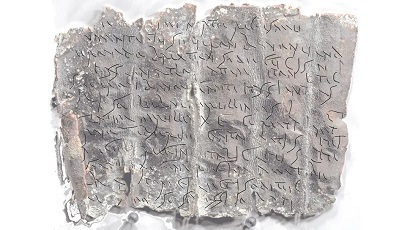
Archaeologists in France have discovered dozens of Roman-era graves of men who were buried with "curse tablets," at least one of which was written in an extinct language, reports Live Science.
Excavations underneath an 18th-century hospital in the town of Orleans, about 120 kilometers southwest of Paris, have revealed more than 60 burials arranged in a single row along a wall.
The cemetery, which dates from the end of the first century to the beginning of the third century, was atypical for this time because the burials were dug in a row, there were no women or children, there were traces of painted wooden coffins, and there were no cremations. This could mean that the dead were from a particular group, such as members of the same profession, according to the Orleans Archaeology Service, which excavated the site.
Even more unusual was the discovery of 21 curse tablets, which are small, rolled-up lead plates with inscriptions on them.
Pierre-Yves Lambert, a Celtic linguistics expert with the French National Center for Scientific Research, has proposed that the F2199 curse tablet is dedicated to "Mars Rigisamu," which is Gaulish for "Mars the Royal," or the Roman god of war. The inscription names several people—in both Latin and Gaulish—to be targeted by the curse for their unjust actions..
While Gaulish continued to be used for several centuries after the Roman conquest of the area, it was seldom written down—so the curse tablets are already yielding important new examples of this vanished language.
A second curse tablet has been subjected to X-ray tomography in an attempt to view the inside without unrolling it. The folded interior has been scanned, but the tablet has not been virtually unrolled yet.
Archaeological excavation at the site will be wrapped up at the end of this month, and researchers will undertake further laboratory analysis of all material uncovered during the dig.