make preferable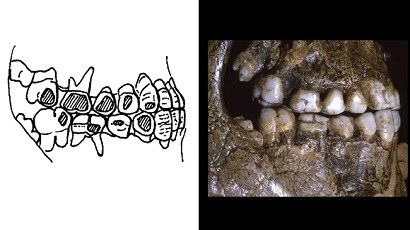
Strange, flat patches on the teeth of ancient Europeans have puzzled archaeologists for centuries. But one researcher thinks he's solved the mystery: Ice age people as young as 10 years old rocked cheek piercings, reports Live Science.
These piercings likely signaled a person's membership in a group, according to John Willman, a biological anthropologist at the University of Coimbra in Portugal, but they also caused teeth to move.
In a study published in the Journal of Paleolithic Archaeology, Willman looked at dozens of skeletons of Pavlovian people, who lived in Central Europe between about 25,000 and 29,000 years ago. His analysis focused specifically on dental wear.
As humans age, the enamel on our teeth wears down through repeated behaviors, like chewing, grinding and sometimes holding objects in our mouths. These activities typically cause dental enamel to become flatter or slightly angled on the chewing surface of the teeth. But in these Stone Age Pavlovian jaws, Willman noticed that the wear was on the cheek side of the teeth instead.
"I thought that the patterns of dental wear caused by labrets were a really good hypothesis for what caused the wear in the Pavlovians," Willman said
The term labret comes from the Latin word for "lip" and refers to a type of piercing that is inserted into a person's lower lip or cheek area.
The use of labrets is well known in both modern and ancient cultures, according to Willman. But to date, no artifacts identified as labrets have been found in Pavlovian burials, possibly because they were made of perishable materials, like wood or leather, that have not survived.
Additionally, he found that adults had a higher degree of cheek-region enamel wear across more teeth than kids did, which may relate to the insertion of larger labrets over time.