make preferable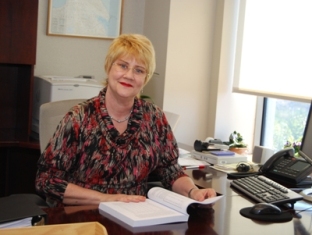
By Anna Ghazaryan
Armenian News-NEWS.am presents an interview with USAID Mission Director in Armenia Dr. Karen Hilliard.
One of the most notable of USAID programs in recent years has become “Support to Armenia-Turkey Rapprochement Project”. Do you think “people’s diplomacy” could weaken the objective obstacles that have been and still exist?
I think that people-to-people projects are a key part of breaking down the barriers between these two countries. It is important to bear in mind that our “Armenia-Turkey Rapprochement Project” was designed right around the time when the protocols were signed with the expectation that they would be ratified. In terms of people-to-people contacts, business linkages and civil society linkages and projects are important. But these were to accompany the government-to-government dialogue that everybody thought would ensue. The project overall did a number of important things, such as to establish business ties, to establish cultural contacts, for example bringing Armenian and Turkish filmmakers together. The overall goal of the project was not achieved, because the government-to-government portion was stalled. Even in view of the official obstacles, it continues to be important to foster business and cultural ties because over time they do break down the stereotypes and pave the way at the grassroots for an acceptance a political solution. While the gains in civil society and business have been modest, it is important to stay the course and hope for а better day.
USAID conducted a campaign within the framework of “Monitoring of 2012 Parliamentary and 2013 Presidential Elections project” to inform voters and then held monitoring of the elections. The program ends in 2014. What work will be done after the elections are over?
This program was designed to bracket the electoral period. We funded “It’s Your Choice” in the period before the elections, through the elections and after the elections. Clearly improving political process is not something that you do only right before election, so it is important from our point of view to support “It’s Your Choice” through the end of this grant, in order to develop their organization internally and work on methods of sustainability after the USAID grant ends. It is important for NGOs like “It’s Your Choice” to work on their internal structure, work on fund raising so they could diversify their funding sources. At the same time it is important to maintain the emphasis even after elections on transparency, on the need for public structures and formal government at the national, regional and local level to remain accountable to the people that elected it. That is why the program continues after elections. Going forward, we will be emphasizing elections less and anti-corruption, transparency, local governance and civil society participation more, in order to take advantage of the five-year period between the major elections. We will work with civil society and government to improve their relationship, to bring them closer and inculcate a philosophy within the government that it must be accountable to its constituents.
IT sector in
First of all we pay a significant attention to the IT sector in part because the government has prioritized it, but it would be a mistake to think that IT gets an exclusive or just disproportionate emphasis from USAID. We are in fact working on four sectors: IT, the pharmaceutical industry, agribusiness and tourism. All of them are an important part of the government’s industrial and economic strategy. IT continues to be important for several reasons. First of all it is a knowledge-based industry that raises the level of available employment for Armenians and offers very well educated workforce, opportunities to use its brain power. Secondly, the IT sector is not dependent on open borders. You can still succeed here with closed borders, too. Thirdly, it takes advantage of natural abilities of the Armenian workforce. IT also is a sector where there is an open field for medium-sized and small business; there is no monopoly that one has to break to be successful. We are working to encourage startups, small businesses; secondly, to continue to training of the workforce here in
Alternative energy projects were promoted within the framework of “Water and Energy”. What are the prospects of using alternative energy for the consumers?
We do have significant investment in the “Clear Energy and Water Project.” USAID works with the government of
We did a number of activities concerning solar and wind technologies in the Armenian villages, but these technologies require significant capital investment. Even if the villagers want to switch to these technologies, they do not have money to make the initial investment. This is one of the reasons that it is important for the government to pursue a decentralization policy and strengthening of local government, including more revenue sharing at the local level and giving them the means of generating of additional revenue themselves, so that they can make investments in this type of thing.
Several weeks ago you launched Finance for Economic Development (FED) Program. What goals does it pursue? What do you expect from this program?
I think, traditionally, the focus of the financial sector of
Black Sea Silk Road Corridor (BSSRC) Project is not only a very interesting project aimed at promotion of tourism, but it is also a project presenting the history and culture of the region. How will
This project is a cornerstone of our strategy to improve the tourism sector in
This is where USAID is placing its emphasis in the tourism sector. This project is aimed at taking advantage of the rich culture and history of