Preferred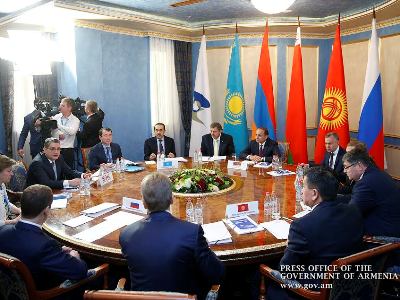
The subsequent session of the Eurasian Intergovernmental Council took place Friday.
The session kicked off in a restricted format, being followed by an extended session.
The PM welcomed those present, noting the positive dynamics in the establishment of a common market of goods and services at the current stage of the EAEU development.
The PM also attached importance to the expansion of cooperation in international and other formats, as well as the closer trade and economic cooperation of EAEU with separate states, which will enable to raise the EAEU development level.
In this context, Abrahamyan considered the cooperation with China as one of the key issues on the meeting agenda. According to him, the establishment of legal framework of cooperation between EAEU and China will enable to not only increase the volume of trade, but also involve investments for large infrastructure projects and diversify logistical opportunities. In this regard, the PM attached importance to the work aimed at establishing China’s Silk Road Economic Belt. Having a historical experience, and being the only EAEU country to have land border with Iran, Armenia is ready to implement that project, Abrahamyan said.
He also attached special attention to the formation of common markets in the EAEU, whose activity will enable to eliminate the obstacles on the way to the movement of goods, as well as increase the speed and volume of economic cooperation between the states.
For his part, Russian PM Dmitry Medvedev attached importance to the regular meetings in terms of activating the integration processes and solving the issues set before them. He considered it necessary to reinforce the legal framework of the Union, fully ensure the free movement of goods, services, capital and persons, eliminate the obstacles and limitations, as well as form common markets in key areas of economy.
The Russian PM also attached importance to the speedy adoption of the EAEU Customs Code in order to ensure clear, foreseeable and favorable legal framework for the business community. Medvedev noted that it is necessary to develop trade and economic ties with the key partners, including China, Vietnam, Southeastern Asia and other states.
Kazakhstan PM Karim Massimov attached importance to the trade between EAEU and states such as India, Egypt, Iran, etc.
In his speech, Belarus PM Andrei Kobyakov considered as a priority the concept paper on the formation of common markets of oil and oil products, attaching importance to the adoption of the Eurasian Union Customs Code.
In the words of Kyrgyzstan PM Sooronbai Zheenbekov, the targeted and consistent work with the EAEU countries is a key direction.
The session also addressed the concept paper on the formation of common markets of oil and oil products, implementation of the provisions of the report on coordinated transportation policy, draft decisions of the Eurasian Economic Commission, etc.
As a result of the session, the aforementioned documents, which strengthen the economic cooperation between the member states, were approved and signed. The document on the negotiations on signing a trade and economic agreement between EAEU member states and China was also signed.
Pursuant to the decision, the next session of the Eurasian Economic Commission will be held on August 12 in Sochi.