Preferred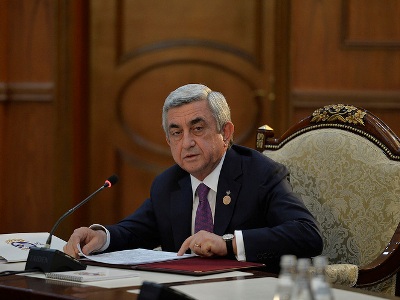
Hot spots of tension and resistance remain in the territory of the CIS cooperation, President of Armenia Serzh Sargsyan said the aforementioned at the restricted format session of the Council of CIS Heads of States kicked off in Bishkek on Friday.
In his speech, Sargsyan first offered condolences to the prime minister and Acting President of Uzbekistan Shavkat Miromonovich Mirziyoyev in connection with the death of President Islam Karimov.
“This year is a jubilee one for both CIS and our countries: We are celebrating the 25th anniversary of independence of our countries and formation of the Commonwealth. Within this period, the CIS has showed itself as an important interstate format for searching answers to complex questions, which we faced in the early 90s. The Commonwealth contributed to maintaining economic, humanitarian, political and other ties in the post-Soviet area, as well as further development in the conditions of the state construction in our countries,” he noted.
According to Sargsyan, 2016 is a unique 'borderline' to give a meaning to the 25th anniversary of the Commonwealth’s experience, objectively and impartially analyze its activity and identify the guidelines for the further development of CIS and its adaptation to the modern reality.
In the conditions of the existence of other integration units on the post-Soviet area, increasing the effectiveness of the Commonwealth and giving new impetus to the multi-lateral cooperation in this format should become the key aim of the adaptation, he added.
“Exactly in this context does the Armenian side consider and support the draft Decision on CIS Adaptation, which also stipulates delegation of a number of issues to the CIS Council of Foreign Ministers, the Economic Council and permanent authorized representatives, with which we might have even lagged behind,” Sargsyan stressed.
In his words, an escalation of tension is still observed in the world, including in certain CIS regions: the activity of terrorist groups is growing, high level of economic instability retains and migration crisis continues.
The President expressed hope that the recent Russian-American agreements on ceasefire in Syria will create preconditions for the long-term settlement of this bloody conflict.
“Unfortunately, spots of tension and resistance retain in the area of our Commonwealth as well. This April – for the first time after the establishment of ceasefire in 1994 – the war was resumed in Nagorno-Karabakh region. These actions resulted not only in military losses, but also in casualties among the civilian population, also seriously undermining the negotiation process.
I am touching on this topic, since the Protocol on Ceasefire, which was based on the provisions of the Statement of the Council of CIS member-states (signed on 15 April 1994), was signed exactly here, in Bishkek. Nursultan Abishevich witnessed this; he also took part in the process. That is, the CIS states are in a sense guarantors of the implementation of that open-ended agreement, which underscores the necessity to achieve full settlement of the conflict exclusively through political means. We have always expressed our position, which is in line with that of the OSCE Minsk Group, i.e. settlement of the conflict through peaceful talks based on the norms and principles of the international law, as well as reasonable compromises. I reiterate, reasonable compromises,” Sargsyan said.
He also expressed gratitude to the Russian President Vladimir Putin and the Russian side, which together with the other OSCE Minsk Group Co-Chairs – France and U.S. – takes relevant steps for the political and diplomatic settlement of the Karabakh conflict and implementation of the agreements reached during the Vienna and Saint Petersburg summits. “This is first of all the unconditional implementation of tripartite open-ended ceasefire agreements of 1994 and 1995, establishment of incident investigation mechanisms and expansion of the office of the personal representative of the OSCE Chairman-in-Office. We presume that the consistent implementation of the aforementioned agreements will create relevant atmosphere for the progress of the negotiation process,” Sargsyan added.
The President noted that the CIS countries are in the process of consistent enhancement of their state governance. For Armenia this is a path to ensure the rule of law, improve its system of administration, develop its economy, as well as increase the independence of the judicial system, strengthen the civil society and support the freedom of press.
To enhance the role and increase the efficiency of those institutions, last year Armenia held a referendum on constitutional reforms, he noted. The new Constitution corrects the balance between the powers and duties of the branches of government, ensuring a higher level of protection of human right and freedoms and increasing the role of public, artistic, professional and political unions.
Sargsyan also noted that for the first time in 25 years of Armenia’s independence, the parliamentary majority and opposition, together with the participation of the civil society, reached a consensus on the Electoral Code of Armenia this week. The parliamentary elections will take place in the country in already several months. “The Republic of Armenia will send corresponding invitations to all the partners to take part in international observations missions, including in the CIS mission format,” he said.
“Currently new Government is being formed in Armenia. Our task is to give new impetus to the development of economy in Armenia, increase the volume of economic growth and the export of Armenian goods and services,” he noted.