make preferable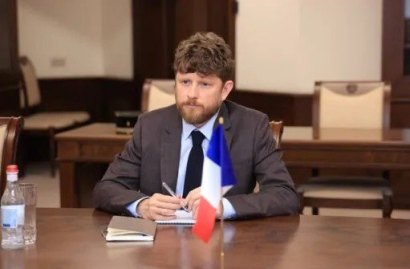
The Public Radio of Armenia conducted an interview with French Ambassador Olivier Decottignies, the text of which we present below.
Mr. Ambassador, thank you for this unique opportunity for an interview. I have many questions, and how would you like to start the conversation?
First of all, I would like to thank you for your invitation. It is a great honor for me to talk to you on Public Radio. It is still the beginning of 2025, and I would like to express my wish that this year be an extraordinary year for Armenian-French relations in terms of our cultural relations, economic relations, cooperation in the defense sector, and everything thanks to which the Armenian and French peoples have such close relations.
You recently returned from France, where you attended the Pashinyan-Macron meeting on February 10. What new messages did you return with?
First of all, the mere fact that that meeting took place already testifies to the importance that Armenia has for France, and also to the personal relations that exist between President Macron and Prime Minister Pashinyan. Just like at the La Francophonie summit held last fall, every time an important international event takes place in Paris, Prime Minister Pashinyan first participates in that event, and secondly, the French President always finds time to meet with him separately to talk about bilateral relations. In other words, this meeting once again testifies to the very high level of our relations.
Both the French President and the Armenian Prime Minister have given us direction to continue cooperation in energy, defense, transport, and other domains. Naturally, in Paris they also spoke about the situation in the region, discussions with Azerbaijan. France’s position on this issue is very clear: the goal is to reach a peace agreement; and first and foremost, the territorial integrity, sovereignty, and democracy of Armenia must be respected.
The defense sector is key in the multi-sectoral cooperation between Armenia and France. On December 10 of last year, the two countries signed a defense cooperation program for 2025. What new actions are planned in this regard that we can publicize?
Defense cooperation between Armenia and France is actually still new, but it is developing very quickly. By 2025, it will have three main directions. The first is the provision of defense equipment to Armenia. France, by the way, is the only Western country that provides defense equipment to Armenia; we hope that other countries will follow us. The second direction is the training of Armenian military personnel—both in Armenia and in France. The third direction is the advisory services being provided to the Armenian Ministry of Defense, which will enable to improve and strengthen the Armenian army.
[Azerbaijani president] Aliyev announced on January 8 that France and other countries supplying weapons to Armenia “must cancel these contracts, Armenia must immediately stop arming itself,” and that “the weapons delivered to Armenia must be returned.” Paris’ response?
Paris’s position is that defense cooperation with Armenia continues. And it continues with the same goal: to help Armenia defend its territory, its population, and its sovereignty.
Armenia has repeatedly stated that “having a combat-ready army is its sovereign right,” and that it is acquiring defensive weapons. In this context, how do you perceive Aliyev’s statement that “we take what we say very seriously”? Is this a threat, a warning of escalation?
Naturally, there are worrying statements. However, when we observe the situation here, we see that there is relative stability; that is, there have been no serious military incidents, deaths or injuries, for about a year; and this is partly due to the EU European Monitoring Mission [in Armenia], which is on the ground and which can warn in the event of any incident, which can also clarify fake news, expose them. But, naturally, there is cause for concern because as long as there is no peace treaty, the possibility of armed conflict always exists. That is why we continue our cooperation in the defense sector and support Armenia in achieving peace.
The head of the European Union mission also stated that no particular tension was observed. In fact, you also say that you do not observe a background of escalation—at least as such.
It is necessary to single out several things. There have been no serious incidents for about a year. At the same time, according to our observation, since last summer, there has been no particular progress in the peace negotiations. As long as there is no peace agreement, the conflict may resume. Today, the situation is more or less peaceful, but it is not stable, so we must do our utmost to achieve peace, a stable peace.
The mandate of the EU Monitoring Mission in Armenia was extended for two years, which Baku was against. The importance of this mission is emphasized especially in the sense that Baku refuses to apply investigative mechanisms on the border, which Armenia consistently proposes. What does this say?
I think the situation in this regard is very clear. We are talking about a European mission located on the territory of Armenia; that is, it is the Armenians who have the legitimate right to apply for its extension, and it is the Europeans who decide. Azerbaijan was also offered to deploy a mission on the Azerbaijani side, but Azerbaijan refused.
Indeed, there is a proposal from the Armenian government to create an investigative mechanism that would enable a clear understanding of the incidents. Naturally, this would help reduce tension, but this proposal is being discussed between Azerbaijan and Armenia, this is not being done within the framework of the European mission.
It is a fact that the European mission is patrolling these areas and the military contact line because there are Azerbaijani positions on the territory of Armenia as well, the incidents have decreased, so we can clearly say that this has a positive impact on the stability of Armenia. And various European leaders who have visited the headquarters here or patrolled with them have noted, on the one hand, that the monitors have a very high level of professionalism, and on the other hand, that their mere presence already inspires confidence in the border population, and this population, let us remember, lives in the areas that are under the greatest threat. And there is a great warmth and gratitude towards the monitors from this side.
Yerevan announces that it is ready to sign the peace treaty without delay and continue the border delimitation. How realistic do you consider these in the context of Baku’s new demands (amendment of the constitution [of Armenia], dissolution of the OSCE Minsk Group). In this context, how close and possible do you consider the peace treaty? And what is your observation regarding the border delimitation process?
The border delimitation work is very positive and very concrete. By the way, as of today, this is the only part of the overall negotiation process that has yielded tangible results. I have had conversations with residents of border towns and villages, for whom as well it is positive and desirable to know exactly where the border really is. This is a positive process that must continue. But, naturally, the negotiation process must also continue because for a complete solution there must be a peace agreement on the one hand, and clear borders on the other.
Let's address Baku's demand to dissolve the Minsk Group. Do you see the viability of the group, the need to maintain it?
This topic should actually be discussed by all participants; that is, both parties of the conflict and the member countries of the Minsk Group. I, as the Ambassador of France, cannot answer this question.; this is a diplomatic matter that involves a number of countries.
How close and realistic do you consider the signing of a peace treaty in the context when Baku openly demonstrates ambitions towards the territories of Armenia, in the context when Azerbaijani troops continue to be stationed on the sovereign territory of Armenia, and some territories of Armenia continue to be occupied?
The basis of the peace agreement should be the principles of the Alma Ata declaration of 1991; that is, international borders should be the administrative borders of the former Soviet republics, which means that the occupying forces that are located beyond these borders should return to their places. Armenia took measures in this regard, evacuating, so to speak, four villages—even if these villages were not inhabited. Azerbaijan should take the same measures on its part.
Can we expect or can we perceive that you are hopeful that the negotiations will yield that result and Azerbaijan will withdraw its troops?
When you are a diplomat, you do not expect; you work in that direction, to achieve a just, lasting peace between Armenia and Azerbaijan, which will be based on the Alma Ata declaration.
Please give your reaction to the term “Western Azerbaijan” used by Azerbaijan. This is another manifestation of territorial claims, which refers to the territories of a number of provinces of Armenia.
It is very simple in reality. From the point of view of international law, there are two legitimate realities: the Republic of Armenia, internationally recognized by its borders, and the Republic of Azerbaijan, internationally recognized by its borders—and that’s it.