make preferable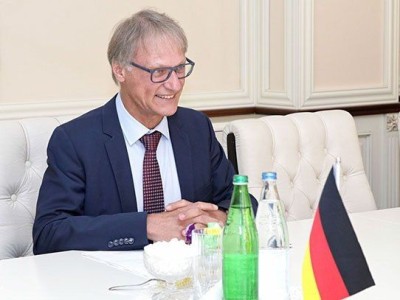
In an interview with Turan news agency, German Ambassador to Azerbaijan Wolfgang Maning made a number of noteworthy statements.
In particular, the ambassador stated that Germany was opposed to the settlement of the conflict by force, and recalled Berlin's calls for the parties to maintain a humanitarian ceasefire in accordance with international humanitarian law. These provisions are reflected in the tripartite declaration of November 10, 2020, which provides for the resolution of humanitarian issues in the Nagorno-Karabakh region. “In this regard, we welcome the agreements reached in November 2020, which can help to resolve these issues and lay the foundation for reconciliation of the parties to the conflict,” the diplomat said.
Germany believes that it is necessary to renew the efforts of the OSCE Minsk Group to ensure the implementation of an agreement. The Ambassador noted that Germany, as a member of the Minsk Group, still believes that the efforts of the OSCE, as a security organization, are necessary to overcome the existing problems and find ways to solve them. "We would like to see all countries of the South Caucasus to become a common zone of peace and prosperity, countries that are economically close connected with other European countries. We want not only strengthen economic cooperation, but also the political understanding among the countries of the region. In this regard, we expect that international organizations will gain access to the Nagorno-Karabakh region. At the appropriate moment, we are ready to discuss with the government the possibility of access to the region for German companies. (…). In addition, participation in the restoration of the territories with the objection of offering economic benefits for Azerbaijan and Armenia is possible within the framework of the European Union Eastern Partnership program, of which both Armenia and Azerbaijan are members.
This is a matter for the future, for now we want to concentrate on humanitarian issues and ensuring the observation of international law,” the diplomat said.
According to him, it is important to be able to overcome hostility, which is difficult to do right away. This takes time. However, in any case, the parties must abandon militant and defamatory rhetoric. Both societies should urge their governments to abandon this.
However, the ambassador's next statement raises many questions: "In this regard, we sincerely welcome the statements of the Azerbaijani authorities that Baku is ready for economic cooperation with Yerevan and that the Armenians living in Karabakh are highly estimated citizens of Azerbaijan," the Ambassador stressed.
To note, the Armenians of Nagorno-Karabakh are not citizens of Azerbaijan, a country that systematically carries out ethnic cleansing against Armenians and incites hatred against Armenians. The political settlement continues, and in this context, the ambassador's statements at least seem strange. At the same time, vague and unaddressed calls for maintaining the ceasefire and improving relations do not add confidence to the aggressor and the victim toward the countries and institutions that voice them.