make preferable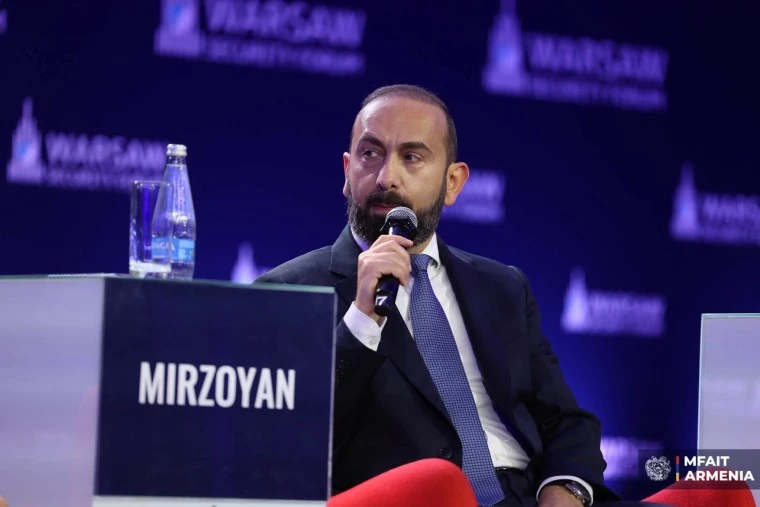
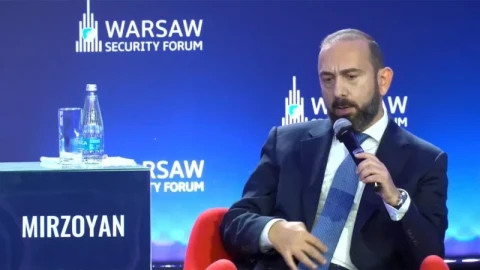
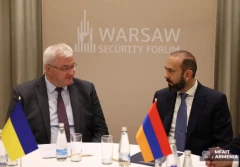
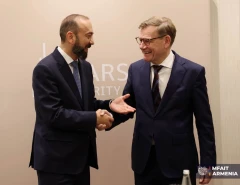
Minister of Foreign Affairs and International Trade of Armenia Ararat Mirzoyan on Tuesday participated in a panel discussion entitled “Half-Baked or Step-by-Step? Rethinking EU Enlargement,” dedicated to the prospects of European Union (EU) enlargement, on the margins of the Warsaw Security Forum, informs the Ministry of Foreign Affairs and International Trade of Armenia.
The discussion featured opening remarks by President of Montenegro Jakov Milatovic. Minister of Foreign Affairs of Lithuania Kestutis Budrys, and Minister of Foreign Affairs of Romania Oana-Silvia Toiu also attended as panelists.
“Moderator: Thank you for that. I’d like to turn to Minister Mirzoyan. We’ve heard that it’s imperative, that it’s a long process, and that it’s tricky. From Yerevan’s perspective, there are a lot of positive dynamics between your country and the European Union. Can you tell us what the destination is when you take this train to Europe? What is the destination for you?
Ararat Mirzoyan: Hello, everybody. I’ll start by describing what we currently have.
Our relations with the European Union are unprecedentedly deep and close, and they cover an unprecedented number of spheres and areas. We have a visa liberalization dialogue. We have had, and still have, the EU Monitoring Mission, which monitors the situation along the Armenia–Azerbaijan border. We have just received a second mission, temporary but operating on a permanent basis, which helps us address hybrid threats. As a non-candidate country, we received autonomous trade measures. This is the most recent news: the EU adopted autonomous trade measures to support the diversification of Armenia’s trade destinations. We also signed an agreement with the European Union that will enable us to take part in various EU missions in different corners of the planet.
Being again, a non-candidate country, we received a Growth and Resilience Plan and EU support. As a non-candidate country, we also received support under the European Peace Facility. So it’s not only about political dialogue, not only about the economy or trade support. It’s also about security, foreign policy, and etc.
I’m saying this to show that, together with the European Union, we are in the middle of a process of continuously exploring new horizons in the sense of bringing the EU and Armenia closer and closer.
Your question is: what is the destination, the final point? I’m afraid I will disappoint you. I believe no one knows. Not Armenia, not the EU, not the member states. Let me try to explain the real situation.
In Armenia, to be very frank, the serious conversation about EU membership has just started. We have not had deep public deliberations on this issue, although in spring 2025 we adopted a law about starting the process of accession to the European Union. That is the Armenian side, the Armenian perception.
Now let’s look at the EU’s perception. We just heard a couple of reflections on this.
Then there is a third layer, which in our case is very important: Armenia’s neighborhood. Let’s list our neighbors. Azerbaijan: we have just established peace, and we have started bilateral trade. We are opening each other’s territories for transportation and transit. We are unblocking regional communications. But there are still several sensitive issues that need to be addressed.
To the west is Türkiye, with whom we have a very intense dialogue. We are normalizing relations, but the border is still closed. To the south is Iran, with its own difficult surroundings, circumstances, and issues. To the north are Georgia and Russia.
As for Russia, you can imagine the reaction and the relations with this country. Historically we have been very close, and we still have very strong ties, but the possible reaction has to be managed. No one wants to create new enemies , and we have no interest in harming any third party.
As for Georgia, imagine how much easier life would become if Georgia continued its EU integration path. That would make a difference, and it would change the conversation with Foreign Minister on this stage.
So, coming back to the main question: I believe no one knows the final destination. But the good news, at least in my impression, is that both of us, Armenia and the European Union, including the member states, are enjoying the process. So let’s enjoy these sweet relations, explore new opportunities and new layers, and at some point in the future we will discuss together whether we should marry or not.
(...)
Moderator: Thank you very much. In British English there’s an expression: it’s better to travel hopefully than to arrive. Given the state of politics in the European Union, that may be appropriate.
Moderator: Thank you very much for that. Minister Mirzoyan, I’d like to bring you back to something you already touched on: Armenia’s regional context and its neighbors. Could you tell us more about how your strengthening relations with the European Union, of which you gave many examples, could serve as a lever, a vehicle for positive change with Azerbaijan or Türkiye, for instance? How can it help you strengthen relations with your neighbors?
Ararat Mirzoyan: My direct and frank answer is that these two topics may not be very closely connected, because we will be improving our relations with our neighbors regardless. That is not connected to our European policy and European aspirations.
On the other hand, we should acknowledge that if our aspiration is to become a full member of the European Union, then having problems or conflicts with our neighbors would probably harm the process.
At the same time, we should also hear what Mr. President has been saying over the last several minutes. They have fulfilled all the chapters. They have all the necessary ticks, sub-ticks, and sub-sub-ticks. And we should acknowledge that, at the end of the day, it has always been a political decision. So where is the political decision on Montenegro? This is very important for Armenia to analyze when planning our own actions. We have also heard the Minister describe how decisions are made backstage, behind the scenes. These are all important considerations for our own decision-making.
So, coming back to your question: regardless, we will keep improving, and we are almost there. We have peace with Azerbaijan, though several steps still remain. We are normalizing relations with Türkiye. The border is still closed, but I think the process has matured considerably, and we could easily wake up tomorrow morning to a headline in the news feed saying the Armenia–Türkiye border is open.
(...)
Moderator: Let’s hope for that. Thank you all for that positive set of indications.
Moderator: Thank you for that. Minister Mirzoyan, final words on the United States and its role in your region?
Ararat Mirzoyan: I would prefer to leave the assessment of U.S.–EU relations to officials from the EU and the United States. What I can say is that in my country, and probably in the South Caucasus in general, their interests do not contradict each other, and they cooperate wonderfully.
As you know, the United States is heavily involved in opening and unblocking transport communications in the South Caucasus, particularly between Armenia and Azerbaijan. This will be a crucial link for communication and transportation between, for instance, Portugal and China, between West and East. The EU and its member states are among the beneficiaries of this process, I believe. So in unblocking the South Caucasus, the interests of many countries and poles in the world coincide.”