make preferable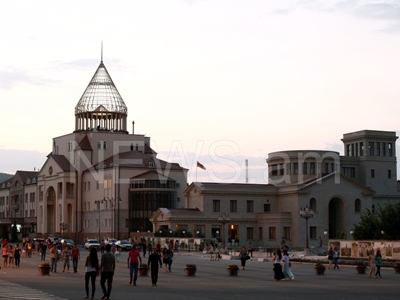
Armenian News – NEWs.am presents the abridged version of the article by journalist Lucas Goetz, published on the openDemocracy website:
“The Nagorno-Karabakh Republic has managed to pursue a dynamic European and global foreign policy. Not bad for a country that doesn't officially exist.
Even before the polls closed, reactions from the international community came in. A spokesperson of the European foreign policy Chief Federica Mogherini stated that ‘the European Union does not recognise the constitutional and legal framework of the elections'. The United States State Department indicated that ‘it will not accept the results of the elections’.
These comments were not made after the recent elections in Turkmenistan, where the current president was elected with 97.14% of the votes. Nor were they made after the presidential elections in Kazakhstan, which saw its current president re-elected with 97.75% of the votes in April.
These statements concerned an election which was described by about 100 international observers as ‘in line with international standards’, ‘orderly, free, secret and equal’ with a turnout ‘many European countries would dream of’. The only problem was that these parliamentary elections took place in an internationally unrecognised state: the Nagorno-Karabakh Republic.
Despite being unsuccessful in achieving any formal international recognition, the Nagorno-Karabakh Republic has actively sought to strengthen its ties with Europe, which is home to a large Armenian community. In doing so it has bypassed traditional diplomatic channels and used other means to attract wider support for its cause.
‘If the Nagorno-Karabakh Republic wants to address any international organization, formally it should be done so via Azerbaijan,’ explains Märta-Lisa Magnusson, Senior Lecturer of Caucasus studies at Malmö University. 'Azerbaijan is a member of the OSCE, Nagorno-Karabakh is not. Azerbaijan is a member of the Council of Europe, Nagorno-Karabakh is not. If these international bodies were to recognize the elections in Nagorno-Karabakh, it would be perceived as an offence by Azerbaijan.'
'Nagorno-Karabakh strives for international recognition, which is important symbolically but also politically. When Nagorno-Karabakh seeks contact with Europe it can be interpreted as a way of manifesting an independent foreign policy towards Europe,’ she says.
David Melkumyan has recently been elected to the National Assembly of the Nagorno-Karabakh Republic. ‘The top priority is achieving international recognition’ he says. ‘We have not been recognized by any country, so we have a lot of work ahead of us. Europe is a natural choice for us because we identify ourselves as Europeans and share the European values.'
Undeterred by the obvious obstacles the Nagorno-Karabakh Republic has managed to conduct an independent foreign policy securing itself a place on the European agenda and in public consciousness. It looks unlikely that Azerbaijan, despite its frequent threats, will try to take Nagorno-Karabakh by force in the foreseeable future. On the other hand it also remains unlikely that Nagorno-Karabakh will soon join the community of universally recognized nations. It seems that for the moment it will remain, in the words of Mr Melkumyan in a state of ‘ ни войны, ни мир’: neither war nor peace.”