make preferable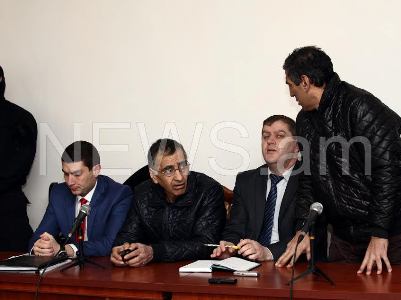
STEPANAKERT. – The detention conditions of Azerbaijani prisoners Dilham Askerov and Shahbaz Guliyev do not differ from those of the other prisoners.
The Human Rights Defender of the Nagorno-Karabakh Republic (NKR), Yuri Hayrapetyan told the aforesaid to Armenian News-NEWS.am.
He noted this commenting on the “explanation” in the Azerbaijani press as to why the Azerbaijani representative is not participating in the meeting of the UN Committee against Torture.
According to Azerbaijani media, the chairman of Azerbaijan’s committee that fights against torture, Elchin Behbudov, refuses to attend the aforementioned meeting and send a report on the situation in Azerbaijan regarding torture, claiming that Askerov and Guliyev are tortured in the NKR.
“The claims on the ‘torturing’ of Askerov and Guliyev do not correspond to reality; they are illogical, at the least” Hayrapetyan said. “Why torture someone who has been convicted by the court and is serving sentence? But if that is not enough, let me remind that representatives of the ICRC mission regularly visit Askerov and Guliyev, and they are aware of their conditions of detention.”
In the NKR Ombudsman’s words, Azerbaijan has yet again manifested a non-serious approach toward serious matters, which it does not wish to resolve.
Azerbaijani sabotage and intelligence-gathering team member Dilham Askerov was charged with espionage; unauthorized border trespass; kidnapping and violence against a minor, committed by an organized group; murder committed by an organized group motivated by ethnic hatred; and attempt of murder of two persons, committed by an organized group, motivated by ethnic hatred. The other team member, Shahbaz Guliyev, on the other hand, was charged with espionage; unauthorized border trespass; kidnapping and violence against a minor, committed by an organized group; and murder committed by an organized group motivated by ethnic hatred.
On December 29, 2014, the First Instance General Jurisdiction Court of the NKR sentenced Askerov and Guliyev to life and 22 years, respectively, in prison.
The NKR Courts of Appeal and Cassation also upheld this verdict.