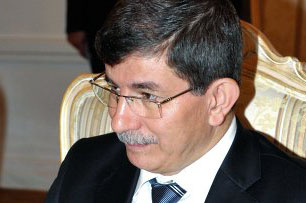
“Turkey cannot afford “to lose Azerbaijan for the sake of relations with Armenia,” Turkish Foreign Minister Ahmet Davutolgu told the Armenian “Azg” newspaper at “Turkey’s policy in the modern world” conference in Istanbul.
Speaking of the fate of the Armenia-Turkey Protocols, Davutoglu said: “In fact, the contacts between Turkey and Armenia began in 2005 when the Turkish government declared its openness to the world and policy of “zero problems with Armenia.” Our talks with the Armenian side pursued three goals: to open the border and establish diplomatic relations, and establish direct and indirect relations between Turkey and Armenia,” he said.
According to him, it refers also to the Armenian Diaspora, “which Turkey considers its diaspora, as they emigrated from Turkey to U.S., France ...”
“Armenians believe that normalization of relations is conditioned by the border opening and diplomatic relations, while we have great experience in such issues. For example, Turkey made great efforts to achieve success in reconciliation between Syria and Israel. However, when it seemed that the issue was to be solved, events in the Gaza Strip took place and all returned to the starting point. The border opening will not bring about changes. There are a number of issues to be solved in this regard. Should we close the border again if anything happens on the Armenian-Azerbaijani border? In this event, all prospects for establishment of relations and conflict resolution will fail in the long term future,” Davutoglu said.
“We cannot afford to lose Azerbaijan for the sake of relations with Armenia. We asked the Armenian President, I have repeatedly offered my Armenian counterpart Nalbandian to return one or two regions of Nagorno-Karabakh, for example, Fizuli or Aghdam to Baku as a gesture to save Azerbaijan’s face. In this case, Azerbaijan would also be ready to open its border, but Armenia refused,” Davutoglu said.
On October 10, 2009, in Zurich, Ministers of Foreign Affairs of Armenia and Turkey signed the “Protocol on the Establishment of Diplomatic Relations” and “Protocol for the development of bilateral relations”, which needed to be ratified by the parliaments of the two countries. However, it did not happen due to Ankara’s non-constructive position.
The signing ceremony was attended by U.S. Secretary of State Hillary Clinton, Russian Foreign Minister Sergey Lavrov and France Bernard Kouchner, as well as Secretary General of the Council of the European Union Javier Solana. The signing ceremony was at the center of the world’s attention, broadcasted on 70 TV channels.
However, on December 7, 2009, Turkey linked Armenian-Turkish reconciliation to settlement of the Nagorno-Karabakh conflict. During his meeting with U.S. President Barack Obama, Turkish Prime Minister Recep Erdogan stated that Ankara would not ratify the Armenian-Turkish protocols as long as the Nagorno-Karabakh conflict remained unsettled. On April 22, 2010, Armenian President Serzh Sargsyan signed a decree suspending the ratification process.

 make preferable