make preferable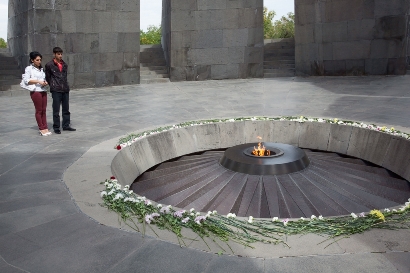
The U.S. House of Representatives has scheduled a vote for this week on a resolution to formally acknowledge the Armenian Genocide, and it appears more likely to succeed than any previous effort. This is what Joshua Kucera writes on Eurasianet.
The U.S. House of Representatives has scheduled a vote for this week on a resolution to formally acknowledge the genocide, fast-tracked as a result of Turkey’s military operation in northern Syria. It will be the first such vote in more than 30 years, and appears more likely to succeed than any previous effort, the author writes.
While it is nearly universally acknowledged that the Ottoman Empire committed a genocide against Armenians starting in 1915, Turkey has vigorously opposed labeling the events as such. During the Cold War, Ankara was one of the U.S.’s closest allies and it has in the past been able to use its clout in Washington to block any attempts at formal genocide recognition.But U.S.-Turkey ties have degraded badly in recent years, and have hit a nadir in recent weeks as Turkey has undertaken a military operation in northern Syria against the U.S.’s erstwhile Kurdish allies there.
Analysts and activists in Washington believe that Turkey’s influence there is no longer strong enough to withstand this latest drive for genocide recognition.
“Ankara has seen its base of advocates and apologists on Capitol Hill steadily erode over the past two decades,” Aram Hamparian, executive director of the Armenian National Committee of America, one of the leading Armenian-American lobbying groups, told Eurasianet. An anti-Turkey coalition among U.S. lawmakers has been growing, Hamparian said, which he described as “hawks, legislators who prioritize international religious freedom, the U.S.-Israel alliance, basic human rights, and many other priorities.”
Turkey “likely has made enough enemies” for the resolution to pass, said Alan Makovsky, a senior fellow at the Washington think tank Center for American Progress who studies Turkey.
“Traditionally, the administration lobbies against it, warning that it would seriously corrode U.S.-Turkish relations. Given the current deterioration of bilateral relations … I doubt the administration would try to make that argument. Were it inclined to do so, it would likely fall on deaf ears in Congress,” Makovsky told Eurasianet.
“This would seem to be the opportune time” for the House to pass a genocide recognition resolution, Makovsky added.
There could also be action from the White House: President Trump’s advisers gave him a range of options to respond to Turkey’s military actions, one of which was that he could recognize the Armenian genocide, a White House adviser told Newsweek.
Although many of the House bill’s sponsors are longtime advocates of genocide recognition, some have promoted the issue now as a means of punishing Turkey for its operation in Syria.
“Now would be a good time for the United States to recognize the Armenian Genocide,” tweeted Ted Lieu, a Democratic representative from California, on October 14. “For too long, presidents like @realDonaldTrump were too afraid to acknowledge this historical truth out of respect for Turkey. Turkey no longer deserves our respect or our assistance.”
John Evans, who was effectively fired from his job as U.S. ambassador to Armenia after calling the events of 1915 a genocide, has since become one of the U.S.’s leading advocates for formal U.S. government recognition.
But now may not be the right time, he said.
“Although it is high time the Armenian Genocide was universally recognized, to do so as a way of lashing out at Turkey seems to be inadvisable,” Evans, who made his controversial comments in 2005 and was subsequently prematurely recalled from his position in Yerevan, told Eurasianet. “Both because it instrumentalizes, or misuses, a serious issue; and because it is likely to cause a major backlash among the Turks, who are literally on the warpath just now. I have always maintained that the important thing is for the Turks themselves to come to terms with their history, not for others to do so," said Evans.