make preferable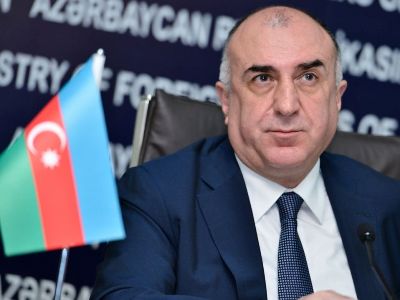
The only difference between the April 21 meeting and the previous rounds of talks to resolve the Nagorno-Karabakh conflict was its remote order, said Azerbaijani FM Elmar Mammadyarov in an interview with minval.az.
His remarks came in response to comment on a video conference with the Armenian FM Zohrab Mnatsakanyan and the OSCE Minsk Group co-chairs.
The Azerbaijani side supports substantive and result-oriented talks to resolve the conflict and has always said that Azerbaijan will use them while the possibilities of a peaceful settlement are being examined.
At the same time, it’s quite obvious: referring to both the supreme law of our state and international law, Azerbaijan has every right to restore its territorial integrity by all means within its internationally recognized borders, as recorded in the UN Charter, the Helsinki Final Act, The Paris Charter, and the well-known UN Security Council resolutions, he added.
Before the meeting, Russian FM Sergei Lavrov expressed his position on a phased settlement of the conflict, which for many years has been the subject of discussion and is reflected in the statements of the co-chairs, he said.
As the FM noted, in turn, the Armenian FM voiced a remark that the issue of returning lands was not considered, and also touched upon the issues of security and the principle of self-determination of peoples. He made this rhetorical attack to calm the internal audience, the Azerbaijani FM said.
According to Mammadyarov, if you ask what the Azerbaijani MFA has done in this regard, the Azerbaijani side has shown that it does not differ in word and deed, its position is unchanged, and its only goal is to free the internationally recognized territories and restore the rights of the internally displaced persons.
"In other words, the occupying country has so far voiced many statements, completely groundless, misleading, and aimed at deceiving the international community," the FM said. "Feeling driven into a dead-end in the framework of the negotiation process, Armenia is taking steps to disrupt it, carrying out provocations. This is what they want to achieve - to damage the negotiation process while shifting responsibility to Azerbaijan."
“Based on the logic of the Armenian side, the ministers of the two countries and the co-chairs representing the three permanent members of the UN Security Council, as well as the ministers of the co-chairs participating in this process have nothing more to do than come to meetings for a cup of tea. Talks are known to be confidential. Their details were not disclosed, but the general framework of talks to this day has already been outlined by the co-chairs, as well as in statements at the level of the leaders of the co-chairing countries," the FM noted.
"All of them reflected elements of a phased settlement of the conflict, that is, a step-by-step elimination of the consequences of the conflict, where the initial stage was the liberation of the occupied territories around Nagorno-Karabakh, the return of Azerbaijanis expelled from these territories, and the opening of communications between Azerbaijan and Armenia," he said. "It is supposed to provide conditions for the joint residence of both communities of the Nagorno-Karabakh region for some time, with consideration at subsequent stages of the status of the region in the framework of observing the territorial integrity of Azerbaijan."
Asked to comment whether diplomacy in Karabakh has a chance, the Azerbaijani FM said: “As a person who has been directly involved in negotiations for many years, I personally believe that there is an opportunity to resolve the conflict through talks, it is only necessary that the parties demonstrate a political the will."
"Look, we have experienced the devastation and losses that war can bring, we are well aware of the progress that peace can bring to the region if the conflict is resolved, and we know what the norms and principles of international law require. It is impossible to talk either about security without eliminating the factor of occupation or about human rights without restoring the fundamental rights of hundreds of thousands of people. If we want peace, security, normal good neighborly relations and, eventually, progress, then the grave consequences of the conflict I have indicated must be eliminated, and states must respect each other's territorial integrity within their internationally recognized borders. There is no other formula for the world."