make preferable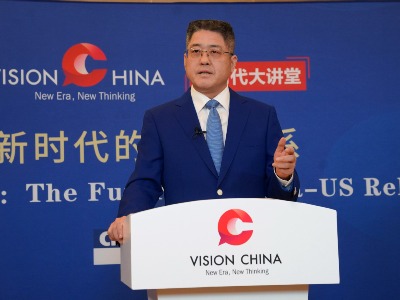
Officials and experts have called on China and the United States to change their tainted relations and called on the new US administration to pursue positive policies to renew relations with Beijing for the benefit of both nations and the world, China Daily reported.
Speaking at the virtual Vision China event hosted by the China Daily on Thursday, Vice Foreign Minister Le Yucheng expressed his hope the new year will bring a fresh start to the Chinese-US relations.
Le said he was impressed by US President Joe Biden's appeal to the US people for unity instead of division in his inaugural speech. "I believe we need exactly the same spirit for China-US relations," he added.
This year marks the 50th anniversary of the historic visit of the former US Secretary of State Henry Kissinger to China, as well as the famous "ping-pong diplomacy". "As the story of 'the tiny ball moved the big ball' goes, it took those great men before us extraordinary wisdom and courage to break the ice in China-US relations," Le said. "The challenges we face today call for the same vision and courage to break the ice again."
Le called on the world's two largest economies to fulfill their important responsibilities for promoting peace and development and to strive to expand their common interests and cooperation. According to him, the joint fight against COVID-19, economic recovery, and climate change can become priority areas for cooperation.
"Anything is possible when China and the United States choose to cooperate," Le said, adding that the two countries can work together to avoid the so-called Thucydides Trap. The term describes the tendency toward conflict when an emerging power threatens to displace an existing power.
The Vision China event, "Moving Forward: The Future of China-US Relations" was broadcast online to a global audience. This was the 17th episode since China Daily launched a series in which influential political, business and academic speakers are invited to tell China's history from a global perspective and discuss major China-related topics of international interest.
In a speech at the event, Zhou Shuchun, publisher and editor-in-chief of China Daily, urged both countries to "stand on the right side of history" in developing their relationship.
Zhou said that it was precisely because governments, politicians and people on both sides decided to "stand on the right side of history" that the two countries broke the ice more than 40 years ago and developed a fruitful relationship. "As a bridge linking China and the world, we at China Daily — and with this Vision China event today — are joining the aspiration to see China-US relations walk on the right side of history as history requires," he added.
In his speech, Stephen S. Roach, a senior fellow at the Yale University's Jackson Institute at Yale University and a former chief economist at Morgan Stanley, said the US-China relations remain a major risk factor in the global economic outlook for 2021.
He suggested that the two countries rethink the nature of the dialogue between them and create a permanent office that deals with all aspects of their relationship on an ongoing basis.
On the resolution of trade disputes between China and the United States, Roach said that Washington needs to view its trade imbalances in the context of the fact that it has a serious shortage of domestic savings.
"So the savings solution needs to be thought of on a medium to longer term basis, not something immediately, but commitment to saving more is the only effective macroeconomic strategy that we can employ to alleviate our enormous and destabilizing multilateral trade imbalance issue," he added.
In resolving the difficulties in relations between the United States and China, Roach proposed to shift the focus of the trade and economic conflict from bilateral trade to structural considerations.
"There's no quick fix to defusing the conflict that has emerged, but I think if we take small steps and began to demonstrate a commitment to conflict resolution rather than conflict escalation, we have a real opportunity as America changes leadership to move from a climate of distrust to a climate that now takes us back to a more trusting relationship between us," Roach said.
Da Wei, a senior fellow at the Center for International Security and Strategy at Tsinghua University, noted the importance of "sustainable" and "effective" dialogue in improving China-US relations and said that both countries need to create some kind of mechanism to stabilize their ties.
He said there were elements of competition in relations between China and the United States, but he did not think that the "the old-style Soviet-US Cold War competition" remained in relations between Beijing and Washington. There are broad areas in which China and the United States can cooperate with each other, he said.
David Firestein, president and CEO of the George H.W. Bush Foundation for US-China Relations has said that the perception that China is a critical competitor to the United States will remain a key element of the US relationship with China.
However, Firestein added that the new US administration is likely to move away from the policies of the Trump administration. According to him, there is an opportunity to "built back better" relations between the US and China under the new US administration.
"The US-China relationship has always been immensely important. It has always been complex. It will remain complex and challenging as we go forward. … And I hope that this is an opportunity where we can take stock of the US-China relationship," Firestein said.
John Ross, a senior fellow at Renmin University of China's Chongyang Institute for Financial Studies and a former director of economic and business policy for the mayor of London, said the inauguration of the new US administration should be "an opportunity to reset China-US relations after the rather negative period".
Ross said the relationship between China and the United States is so important because it affects not only themselves but the entire world. He expressed the hope that the new US administration will adhere to a policy of mutually beneficial cooperation with China instead of the Cold War mentality.