make preferable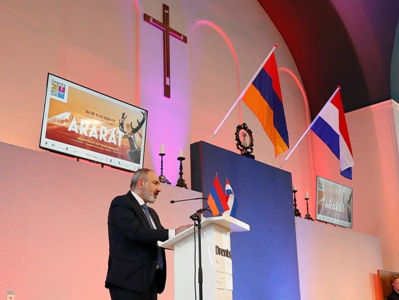
This year Armenian culture is being presented in the Netherlands in an unprecedented manner. The exhibition of the relic and valuable objects from the History Museum of Armenia and Mother See of Holy Etchmiadzin will shed new light on the Armenian cultural heritage deriving from the depths of history. Armenian PM Nikol Pashinyan stated this at Tuesday’s official opening of the "Under the Spell of Mount Ararat: Treasures from Ancient Armenia" exhibition in Drents Museum in Assen, the Netherlands. He added as follows, in particular:
“The exhibition once again demonstrates and reminds the warm and historically friendly relations that exist between the people of Armenia and the Netherlands. Committed to common values and national identities, our peoples have always been open and deeply interested in interpenetrating cultures.
The first mention of the Armenia-Netherlands interactions dates back to the IV century. In the XVII and XVIII centuries, Amsterdam was one of the prominent centers of Armenian printing where Matheos Tsaretsi, Armenian cleric and publisher established a printing house in 1660. In 1666, Voskan Yerevantsi, Armenian clergyman, printed here the first Armenian printed edition of the Bible in 5000 copies based on the Bible written upon the order of Hethum the Second, the 13th-century King of Cilicia. The publisher collaborated with the great Dutch punch cutter Christoffel van Dijck. This is a great example of a cultural interaction and testimony of the same origins of civilization of Armenia and the Netherlands.
Another episode of early interactions between Armenia and Netherlands is that Armenian merchants established commercial houses in the Netherlands in the 16th century. Holy Ghost Revival Church of Amsterdam was built in 1714 by Armenian merchants, which later became the center of social and cultural life for Armenians in Amsterdam. In the 1700s, 70 Armenian families already lived in Amsterdam. One of Amsterdam's ancient bridges, which served as a transit route for Armenian merchants from Jugha in the 17th century, is now called the “Armenian Bridge”.
The presentation of this impressive collection at the Drents Museum, and the bilingual catalog will give us a strong impetus for strengthening the friendship between the two nations and allow thousands of visitors to discover Armenia’s past under the spell of Ararat, which has always been a universal symbol for Armenians and Christians in general, and a guideline for continuity.
I would like to thank the initiators of this project, some of them present here today, those who supported its realization, regardless of difficulties. Special thanks go to the Romashuk-Hayrapetyan family from Assen for their engagement and assistance from the very first day.
Once again, I am truly delighted to attend this occasion and look forward to hosting a similar Dutch exhibition in Armenia.”
Afterwards, 5 figures from different spheres of the Netherlands were awarded the state awards of Armenia for their contribution to the establishment, strengthening, development of friendly relations with the Republic of Armenia, and pro-Armenian activities. Prime Minister Nikol Pashinyan handed over the awards at a ceremony organized at the Drents Museum.
At the proposal of the Prime Minister and by the decree of the President of the Republic of Armenia, on the occasion of the 30th anniversary of Armenia's independence, Inge Drost, Andre Rouvoet, Leen van Dijke, Harry van Bommel and Anna-Maria Mattaar were awarded with state awards of Armenia for their significant contribution to the establishment, strengthening, development of friendly relations with the Republic of Armenia, and to the protection of universal values. In particular, André Rouvoet and Inge Drost were awarded the "Mkhitar Gosh" medal, Harry van Bommel, Leen van Dijke - the "Gratitude" medal, Anna-Maria Mattaar - the "Movses Khorenatsi" medal.
In his speech, the Prime Minister particularly said, “Mrs. Drost, Mr. Rouvoet, Mr. van Dijke, Mr. van Bommel,
I am very glad to welcome you in this solemn ceremony of decorating you with Armenian state awards. I would like to say that this is the expression of our warm gratitude and appreciation for your activity as great friends of Armenia and the Armenian people, and for your support concerning very important topics for Armenia, for international recognition of the Armenian Genocide, promotion and protection of the rights of the people of Artsakh [(Nagorno-Karabakh)].
The popularization of Armenian culture in the Netherlands, the popularization of the Dutch culture in Armenia is very important, which, of course, deepens the bilateral and humanitarian ties between our friendly countries and states. And of course, the political, humanitarian and other support should also be mentioned, and I would like to say that we are grateful to you and we consider you as friends of Armenia and we count on you, and you also can count on us. I hope you will continue your support to Armenian democracy, Armenian peace agenda, and of course, the rights of people of Artsakh and Nagorno-Karabakh.
I believe that as a result of this cooperation and friendship, we can make this world a better place.
Thank you so much and my appreciation on behalf of the Republic of Armenia and the people of the Republic of Armenia, people of Artsakh for your support and friendship.”
The above-mentioned exhibition will be open until October 30. 160 valuable exhibits from the History Museum of Armenia, the Treasury of the Mother See of Holy Etchmiadzin are presented. A unique relic of Noah's Ark is also exhibited.