make preferable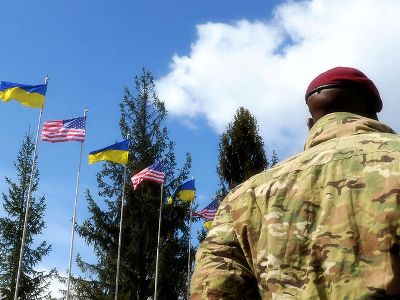
The Wall Street Journal reported last month that the United States plans to name its military mission to support Ukraine and appoint a general to lead the training and assistance effort.
“The naming of the operation,” the Journal said, “formally recognizes the U.S. effort within the military, akin to how the Pentagon dubbed the missions in Iraq and Afghanistan Operation Iraqi Freedom, Operation Enduring Freedom and Operation Freedom’s Sentinel.” What “Operation” will this be? With what incomprehensible moniker will the U.S. effort in Ukraine be dubbed? This war will now have a name. It cannot die; we dare not kill it.
To be sure, U.S. support for Ukraine is, by all accounts, merely support, unlike previous (and many current) U.S. military commitments. Among the competing concepts that the post-Cold War era has produced, the Western foreign policy acropolis accepts as gospel the fact that in today's "rules-based" global order, larger countries that act aggressively against smaller and weaker neighbors should be punished. Despite the exceptions to this consensus on the security policies of states such as Israel and America, it is generally a good principle. World peace has too often been disrupted by the ambitions of revisionist states led by ideologues and imperialists.
But what does it say about our liberally ordered world that its preservation increasingly depends on waging war indefinitely? Will this war include indefinite commitments? Will the financing of the Ukrainian war effort be built seamlessly into the essence of U.S. foreign policy over time, as has happened with many other conflicts? Will the question of its nature and importance not raise accusations of defeatism, which is now a concomitant pathology of the raison d'être of the U.S. security establishment?
A recent piece in Responsible Statecraft added to this chorus of questions. “If this is not acknowledging a deeper level of U.S. military involvement, what is it? And if so, why shouldn’t the American people be wary?”
Nevertheless, this latest move demonstrates the longevity as well as the depth of America's commitment. To name a thing is to give it meaning, identity, and permanence.
For the Ukrainian people, their struggle for survival needs no name. They know it is brutal, violent, and existential. It needs neither sophistry nor taxonomy, but it needs to end. And yet it won't end until one or both sides decide it is necessary. Perhaps the Ukrainians are preparing for a long war, as are their Russian opponents. But they do not consider themselves guileless pawns in some endless border war against a neighboring great power. Nor should the United States.
The name this operation will receive will pay homage to freedom, liberty, or Ukrainian sovereignty. But its meaning may be less lofty, and it may make this "supreme" war the same as any other war America has directly or indirectly pursued and continues to pursue. As the number of Ukrainians dying for their country continues to grow, the United States will gradually assimilate their cause into its defense architecture and ask fewer questions about it.
Whether this war will eventually lead to peace is impossible to predict. But the name should be remembered for what it was and was not, what it did and did not do. Like a storm in the desert. Like Iraqi freedom.