make preferable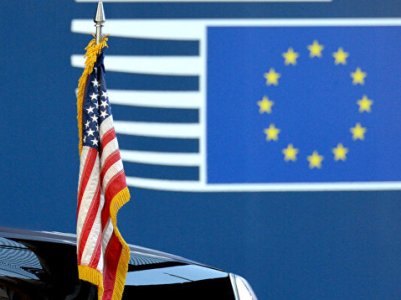
The biggest foreign threat to the Unites States is not Russia and it's not China. It's the European Union and its member states, Newsweek reported.
"This is not to say that Europe is an enemy of the United States or a serious geopolitical competitor. While Europeans like to complain about the vulgarity of American culture, they consume it constantly, en-masse, and relations between the two continents are defined more by a sense of mutual friendship then animosity," the article said.
Beneath the friendly banter, however, a real geopolitical problem has blossomed that is becoming increasingly obvious, though the Europeans are too proud and the U.S. too nostalgic to admit it.
It began in the 1990s with the breakup of the former Yugoslavia, which was supposed to be a small regional conflict that could be managed by the major European powers, especially France and a reunified Germany. Alas, it was U.S. intervention that led to peace in 1995 and then again in 1999, after the crisis involving Serbia and Kosovo.
After the war in the Balkans, Europeans settled into a post-Cold War world ruled by the hegemonic US power that provided security for free. While it was, and still is, fashionable to whine about American domination in European newspapers and university faculties, it was actually an incredibly enjoyable affair. Instead of spending money on defense, Western Europe could use the dividends of American defense to build its generous welfare states.
As a result, the very issue of tough geopolitics was a thing of the past, cared for only by belligerent Americans and their sinister military-industrial complex. According to a 2009 article in the renowned Foreign Policy magazine, Europe was a "classy," "metrosexual superpower," while the U.S. was "fumbling" around the world. And fears about international security faded away.
Now Germany was barely meeting its financial obligations to NATO, which worried both Trump and Obama, although it reflected the attitude of many Europeans: no more threats and rivalries, only economic interests and comfortable lives. It is no coincidence that it was during this period that the now famous Nord Stream 1 and Nord Stream 2 were planned and built.
"As we're learning now, this was wasn't just laziness. It was lunacy," the author noted.
The U.S. provides twice as much aid to Ukraine as the EU and its member states combined, demonstrating that even now Europe has not woken up from its geopolitical slumber, into which the luxury of U.S. protection has driven it.
Washington, on the other hand, seems still unwilling to send its European friends the wake-up call they need, turning them into millstones around America's neck, threatening to drag the US into a sea of geopolitical turmoil. The time has come for the U.S. to free its European satrapies, not out of spite, but in the interest of both sides.
No relationship can work with unilateral dependence, which leads only to resentment and weakness. The U.S. is still strong, but it is not strong enough to face all the major threats from Asia to Eastern Europe alone, and it is time for the EU to take responsibility for its neighborhood.
It would be ridiculous to expect Brussels to intervene in the problems of Mexico or Venezuela, since we intuitively understand that geographic proximity makes Latin America a problem for the United States, not for Europe. Similarly, we should understand that the problems of the Middle East and Eastern Europe should be solved by the EU, not the U.S.
Some tough love from Washington might help. It might be tough, but it's still love.