make preferable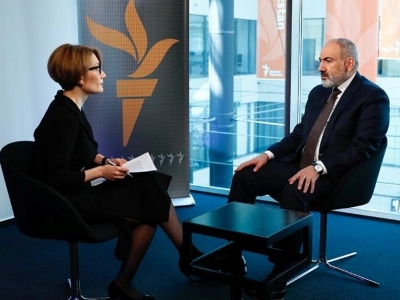
The main disagreements concern Artsakh (Nagorno-Karabakh), but not only that, Armenian Prime Minister Pashinyan stated, answering RFE/RL Armenian Service’s question in Prague as to what the issues are on which the foreign ministers of Armenia and Azerbaijan remained in disagreement after their Washington negotiations.
"Although it was recorded in Prague and Sochi that Armenia and Azerbaijan recognize each other's territorial integrity, we are still unable to reach an agreement on the draft peace treaty’s wording that will give us confidence that Azerbaijan recognizes Armenia's 29,800 square kilometers," said the Armenian PM.
Pashinyan emphasized that there are misinterpretations in addressing the rights of the Armenians of Nagorno-Karabakh, and these misinterpretations are maintained.
"Next, any treaty, even the most unambiguously written ones, have misinterpretations. How these misinterpretations should be resolved is a very important issue; ultimately, the issue of guaranteeing peace after the signing of the peace treaty. Both the international mechanisms and the local one are taken into account, particularly in relation to the withdrawal of troops; should we not have a demilitarized zone? There are misinterpretations regarding addressing the rights of the Armenians of Nagorno-Karabakh, and they are maintained. Of course, there is a certain movement; if before the difference between the positions of the parties was 1 km, now it is 990 meters; it is a movement, but there is still a huge difference," the Armenian premier noted.
To the question as to which option is Armenia moving to suspend the issue of Artsakh and the Russian peacekeepers leave, or should the West provide security guarantees to the Armenians living in Artsakh, Pashinyan replied that Armenia was working on the option that the issue of security and rights of the Armenians of Nagorno-Karabakh should be discussed at a Baku-Stepanakert dialogue platform, which should have a certain international engagement. "Otherwise, that topic and agenda can be simply forgotten by Azerbaijan," he added.
The Armenian PM stated that the discussion that started in Washington can be continued in Moscow, dismissing the claims that there are Western and Russian projects that differ from each other.
"Sometimes I read materials, listen to interviews. I want to understand what people are talking about. If I were not the prime minister, I would think that I don't know something," said Pashinyan, adding that there were approaches from the West, but not an option written on paper.
"The approach is verbal. And if we put it [down], read it on paper, it may turn out that we misunderstood, it's not like that. In August 2022, the Russian side submitted a written proposal, we accepted [it], Azerbaijan rejected [it]. We have not seen a process of Russia putting that option on the [negotiating] table for the second time," the Armenian PM noted.
And when asked if there was a similar attempt in Sochi, Pashinyan repeated his answer that Moscow has never made such an attempt.
"Whenever it [i.e., the Russian version] is put on the [negotiating] table, we are ready to move forward with it. But to what extent does the Russian Federation pursue this option?" added the Armenian premier.