Preferred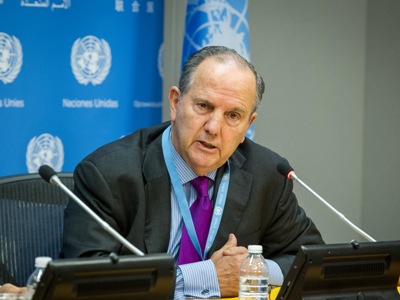
On August 23, Juan Ernesto Mendez—Former Special Advisor to the Secretary-General on the Prevention of Genocide (2004-2007), Professor of Human Rights Law in Residence Commissioner, International Commission of Jurists, and Former UN Special Rapporteur on Torture (2010-16)—at the request of the Permanent Representative of Armenia to the United Nations, presented a preliminary opinion on the situation in Artsakh (Nagorno-Karabakh) and on the need for the international community to adopt measures to prevent atrocity crimes.
In the preliminary opinion, Mendez presented the current situation in Artsakh.
"Under the circumstances, it is my considered opinion that the facts outlined above constitute sufficient reason to proffer an early warning to the international community that the population of Nagorno-Karabakh is at risk of suffering ‘serious bodily or mental harm to members of the group’ (Article 2, paragraph b of the Convention on the Prevention and Punishment of Genocide). The state parties of the Genocide Convention are committed to prevent the crime, and the international community should exercise its responsibilities to protect that population
“I am guided in this conclusion by the jurisprudential precedent adopted by the International Court of Justice in Bosnia v. Serbia regarding the obligation to prevent genocide under the 1948 Convention. In that case, the ICJ [(International Court of Justice)] established that all States have responsibilities to prevent genocide. Those responsibilities are highest in cases where a State is in a position to influence the situation decisively, because of geographic proximity, cultural or political links to the actors on the ground, control of territory and means of communication and transportation, and so on. In the case of Srebrenica, the ICJ found that Serbia had violated its obligation to prevent genocide, among other factors, because it had refused to cooperate with judicial inquiries. By way of analogy, lack of compliance with a binding interim measure issued by the ICJ precisely to protect a population at risk is at least as severe an early warning than refusal to cooperate with judicial investigations,” Juan Ernesto Mendez concluded in his preliminary opinion.