make preferable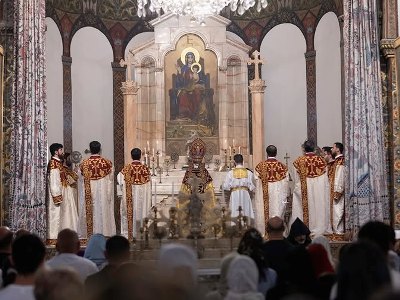
The Mother See of Holy Etchmiadzin has issued a statement on the “uncanonical nature of omitting the names of the Catholicos of All Armenians and the diocesan primate during the Divine Liturgy” of the Armenian Apostolic Church.
“During the Divine Liturgy, the commemoration of the names of the episcopal primate [i.e. the Catholicos] and the diocesan primate—the bishop—has the following fundamental and important meanings:
- liturgical, through which the counsel of the Divine Liturgy is expressed in its entirety, and the Liturgy book—as an official sacred book approved by the Church;
- ecclesiological-canonical, through which the local community gathered around the bread and the cup of the Divine Liturgy is affirmed as part of the Universal Church, whose spiritual leader is the bishop, and the celebrating priest or bishop establishes his ecclesiastical-canonical communion with the Mother Church and its head, the episcopal primate.
In the Armenian Apostolic Church, the earliest testimony of the commemoration of the bishop’s name during the Divine Liturgy is present in the interpretation of the Armenian Church’s liturgy book by Khosrov of Andzev, back in the 10th century. According to Khosrov of Andzev, the commemoration of the bishop’s name [During the Divine Liturgy] is important because the bishop is the overseer of Orthodox doctrine, and through this the priest affirms the sacramental authority received from him and the celebration of the Divine Liturgy in accordance with Orthodox doctrine.
The arbitrary or deliberate omission by the celebrant of the names of the episcopal primate and the bishop [during the Divine Liturgy] is not only contrary to the liturgical canon established in the Universal Church over centuries, but also distorts the full understanding of the counsel of the Divine Liturgy.
The commemoration of these names during the Divine Liturgy makes the assembled church part of the Apostolic and Universal Church. The omission by the celebrant of the names of the episcopal primate and the diocesan leader means that
. the celebrating cleric calls into question the Divine Liturgy being offered on the basis of the Orthodox faith, since the overseers of Orthodoxy are the bishop and the episcopal primate,
. puts himself out of the ecclesiastical communion,
. rejects the authority of the leader of the Church,” the Mother See of Holy Etchmiadzin noted in its statement.