make preferable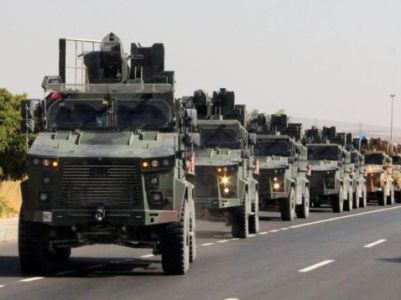
Turkey's impending invasion of northern Syria is driven by "political reasons" rather than national security needs, and it remains unclear how officials will announce the "success of the mission," experts told Fox News Digital.
"This is a politically motivated military incursion rather than a sort of, you know, tactically sound or, you know, strategically oriented ambition," Sinan Ciddi, an expert on Turkish domestic politics and foreign policy for the Foundation for Defense of Democracies, said. "The timing of this operation will have been much closer to the upcoming Turkish presidential election, so they can reap maximum political benefit out of it."
Turkish President Recep Tayyip Erdogan last week ordered a series of airstrikes on Kurdish militias in northern Syria and promised to order a ground invasion of the territory.
The Pentagon urged Turkey to abandon its plan to invade Syria, with U.S. officials warning that the operation could jeopardize U.S. troops in the country.
A spokesman for Turkey's embassy in Washington, D.C., told Fox News Digital that officials have "time and again pointed out threats against our national security, posed by the PKK/YPG terrorist network in Syria and Iraq." "We have always called for unequivocal and genuine solidarity in the face of terrorism in all its forms and manifestations," the spokesperson said. "Notwithstanding, the terrorist organization continued its attacks, recently targeting innocent civilians in the heart of Istanbul."
Sinam Sherkany Mohamad, a representative of the Syrian Democratic Council in the United States, said democratic forces in northern and eastern Syria remain ready for a Turkish invasion, but "hope it will not happen."
"We don't want war, we don't want to create another conflict zone in the region," Mohamad said. "We already, as Syria, suffered a lot [in] 12 years from the Syrian crisis, so we don't want to create another conflict zone or a war in the region that is not in the interest of anyone, neither the United States nor Syrian nor Turkey."
"We hope that the international community and the main powers, like Russia and the United States, could stop us from [facing] any ground invasion in the coming [days and weeks]," she added.
"There are many mechanisms that the U.S. administration can do to prevent Turkey from this ground invasion," she said, stressing that any invasion would result in a "humanitarian catastrophe" with millions of displaced people.
Earlier, Erdogan had proposed creating a "safe zone" for refugees in northern Syria, and on Nov. 25 he promised to carry out his plan after the airstrikes.
But while Turkey advertises its need for a "safe zone," experts say Erdogan's goal is purely political, aimed at distracting Turks from the economic problems facing the country.
"I would say this is an operation … essentially [aims to] divert public attention in Turkey away from the state of the ailing economy and people's anger towards an external sort of manufactured crisis following the terrorist attack that occurred in Istanbul back in mid-November," Ciddi explained, clarifying that while the bombing is real, Erdogan’s government has not provided "any credible information" to link the Kurdish militias to the attack.
"Why just accuse the YPG without any credible or substantial or solid information? Because that's an easy go to the Kurdish issue," Ciddi said.
Soner Cagaptay, director of the Washington Institute's Turkish Research Program, said the military action would seek to create a "safe zone" as Erdogan would seek to seize more YPG territory and "break this into more pieces." "Turkey, through foreign incursions in the last five years, has broken this entity up into multiple pieces, and now it wants to do another incursion to break, create another incision," Cagaptay said.
More important may be Erdogan's relationship with Syrian President Bashar al-Assad: Recent signs suggest that Turkey and Syria have begun working to melt the icy dynamic. The head of Turkish intelligence held several meetings with his Syrian counterpart in September, while Russia encouraged increased cooperation between the two countries.
Chagaptay believes Erdogan's actions in Syria could affect the equation if Turkey can absorb the pieces in exchange for support and recognition, which in turn could lead to an end to Syria's protracted war.
"Assad is going to say, ‘What are you going to do for me?’ and Erdogan is going to say, ‘I recognize you, a Syrian sovereign, sorry for everything I have done,’" Cagaptay said. "And I think that's how the war is probably going to end in Syria."
Kemal Kirisci, a senior fellow at the Brookings Institution's Center for the U.S.-European Project, said Erdogan is in a precarious position because his intentions and loyalties remain unclear. "[Erdogan is] playing around with becoming a member of the Shanghai [Cooperation], and then he's giving Greece a hard time, etc.," Kirisci said. "On the surface of it, it looks like he wants to take Turkey away from the West … ideologically, this is what his preference is."
"Erdogan is very conscious that he cannot afford to be on its own facing the Russian bear," he added. "And he's also extremely aware that he has become too dependent on Putin and Russia."