make preferable
Yesterday, Turkish Minister of Energy and Natural Resources Taner Yıldiz put an end to the empty talk about Azerbaijan’s ability to influence Ankara’s foreign and energy policy in any way. The aim of the empty talk was “enhancing” Azerbaijan’s regional influence by means of rhetoric. In fact, however, Baku exhausted its potential for energy diktat long ago – it has neither the necessary resources nor means of diversifying routes or political weight to torpedo Turkey’s strategic task of becoming the main point for hydrocarbons transit to Europe. That was the reason why billons of U.S. dollars were invested in the Baku-Ceyhan and Baku-Erzurum projects. Leaving the communications inoperative is as impossible for President Ilham Aliyev as yielding his chair to some Isa Gambar.
So the direction for the transit of Caspian resources at Azerbaijan’s disposal can by no means be changed. Another matter is that the reserves are not sufficient to meet both Turkey’s ambitions and Europe’s demands.
Ilham Aliyev is not to blame for the West having been unable to push through the Transcaspian gas main project. As a result, the two pipes of great length designed for supplying energy resources from Central Asia to Europe — the Baku-Ceyhan oil pipeline with an annual capacity of 50m tons, and the South Caucasus gas pipeline Baku-Tbilisi-Erzurum with an annual capacity of up to 30bn cubic meters – actually run only to end in Azerbaijan’s well that is running dry. Strategically, the Baku-Tbilisi-Erzurum gas pipeline was designed for Central Asian gas, rather than for Azerbaijan’s. It was laying the gas main through the bottom of the Caspian Sea than was supposed to make the Baku-Tbilisi-Erzurum gas pipeline part of the Nabucco project. Azerbaijan is capable of supplying only 1/3 of the necessary volume to this pipeline, which can hardly satisfy Turkey and the end consumers in Europe. The designed annual capacity of the Nabucco gas pipeline is 30bn cubic meters, and, in this context, Azerbaijan’s efforts are “a drop in the ocean.” By various estimates, over the following decade, Azerbaijan will be capable of supplying within 5bn cubic meters of gas to this pipeline, whereas at least 15bn cubic meters are required for it to be put into operation. Moreover, the volume Azerbaijan is ensuring now does not reach Turkey in full. Let us remember that Georgia, a transit country which completely upset its relations with Russia, became dependent on Azerbaijani gas, while Turkey “granted” its gas quota in the Baku-Tbilisi-Erzurum pipeline to Georgians. So Turkey has never received strategic amount of gas from Azerbaijan and hardly expects to receive it.
Realizing that Russia will go all out to prevent a pipe from being laid through the Caspian bottom, Turkey, without wasting time, joined the Russia-launched South Stream project. The difference of this project from Nabucco is as follows: from Central Asia the pipeline will run along the northern Caspian coast (a Near-Caspian gas pipeline), rather than through the bottom of the Caspian Sea, which, however, is not of essential importance for Turkey. On the contrary, this reduces the number of transit countries between Central Asia and Turkey — Russia in place of Azerbaijan and Georgia. The efforts exerted by RF Prime Minister Vladimir Putin and his Italian counterpart Silvio Berlusconi were crowned with success – Turkey joined the South Stream project. At that very moment Azerbaijan felt the hard slap delivered by its “big brother” – it was not while Yerevan and Ankara were signing the Protocols in Zurich.
The second slap proved to be even header. Baku got it yesterday, when Turkish Premier Recep Tayyip Erdogan and Minister of Energy and Natural Resources Taner Yildiz agreed on the details of Turkey’s participation in the South Pars project with Iran. It is the world's largest gas field coverings an area of 9,700 square kilometers, with 3,700 square kilometers (South Pars) being in Iranian territorial waters. It can really serve as resource base for the Nabucco project, but Azerbaijan drops out of the game. Moreover, the West may share the same fate, as Turkey seems to be going to “uncap the Iranian barrel” with Russia. So Russia is “drawing” Central Asian resources into the South Stream and Blue Stream projects, while Turkey is ensuring access to the European market for Iranian gas. Thus, Europe’s energy security problem can be resolved by combined efforts of Turkey and Russia, with Iran’s energy potential necessarily used.
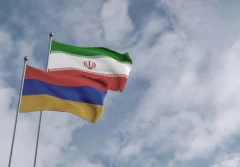
Armenia may play a key role in the Turkey-Iran-Russia energy triangle. In any case, over the last few years, Russia, slowly but surely, has been creating a powerful “electric energy base” in Armenia. With the Iran-Armenia gas main considered, Armenia’s prospects will be even better after the Armenian-Turkish border has been reopened.
As regards Azerbaijan, the only thing for it to do is to feed the West promises, beg compensation of Turkey for gas at a giveaway price and try to get Russia’s support by supplying ridiculously small volumes of gas (500m cubic meters) to the Gazprom Company by means of bypass routes.