make preferable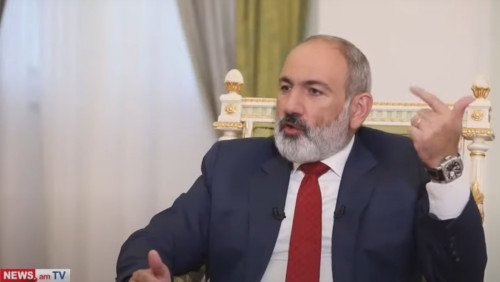
Russia itself leaves the region by virtue of a number of steps it takes or fails to take. Armenian Prime Minister Nikol Pashinyan said this in an interview to the Italian La Repubblica newspaper, when asked what the political reason is for Russia to leave the control of the Lachin corridor to Azerbaijan
"Of course, we talk about these issues with our Russian partners. But irrespective of these discussions, we of course have our own hypothesis. When we talk about this hypothesis, also several events that took place in Russia push us to draw historical parallels.
"Our region has already witnessed such a situation. In fact, for quite a long time the Russian Federation is present in our region, the South Caucasus. But we have observed situations when overnight, within a month or within a year the Russian Federation just got up and left South Caucasus.
“Our Russian colleagues talk a lot about that Armenia’s western partners, western countries work with Armenia or push the government of Armenia in order the Armenian government takes measures, pursuing the objective to push out Russia from this region.
"But when we talk with our Russian partners, sometimes we express our opinion and our assessment that it’s the opposite, we see that Russia by virtue of a number of steps it takes or fails to take, itself leaves the region. As for the reasons, we are unaware. We can of course make interpretations, but I cannot make any statement. I can propose hypothesis, but I will refrain from that now. It’s understandable that the issue you refer to is a matter of great concern and interest for us and there is nothing new here. But there are processes which of course lead us to believe that all this scenarios may repeat, we just can wake up one day and see that Russia is not here," he said.
According to Pashinyan, the Lachin corridor, which should have been under the control of the Russian peacekeepers, is not under the control of the Russian peacekeepers.
“There may be two reasons: either the Russian Federation cannot maintain control over the Lachin corridor, or it just doesn’t want to. Both are problematic from our perspective," he added.
To the reporter's follow-up question as to whether this because they don’t want or because they cannot maintain control over the Lachin corridor, Pashinyan responded that sometimes they cannot, and sometimes they do not want to.
"But I would not like to speak about that. Of course, I have my own versions, my own perception, my own hypothesis, and I have publicly expressed part of them. Of course, in those public statements the causative relationships may not have been very visible, but a careful observer will see those causative links.
"Let’s see what makes this situation dangerous for Armenia. We have not been able to make use of its toolkit. Armenia is a member of the CSTO, Armenia is a member of the Eurasian Economic Union, Armenia has a strategic partnership treaty with the Russian Federation, and all these leads all western countries or experts to qualify Armenia as a pro-Russian country. On the other hand, many circles in Russia consider Armenia or its government, and since the government was formed by the vote of the majority of the people, pro-Western. And here the biggest problem of our current position is as follows: if being pro-Russian could have some potential benefits, or if being pro-Western could have some advantages, Armenia does not take advantage of the benefits of being pro-Russian, because in Russia they do not consider Armenia enough pro-Russian, for example for the reason that Armenia in their opinion does not provide enough assistance to them in the Ukrainian issue. On the other hand, Armenia cannot take advantage of the potential benefits of being pro-Western, because in the West they consider Armenia not to be sufficiently pro-Western, because for example, from their perspective, Armenia does not sufficiently oppose Russia in the Ukrainian issue. This is exactly the hazard of our situation," Nikol Pashinyan said.