make preferable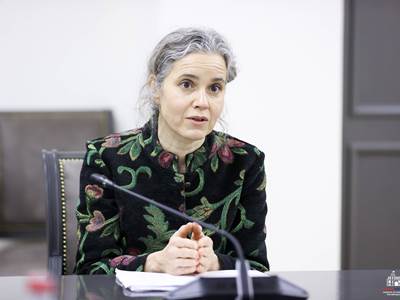
EU Special Representative for the South Caucasus and the crisis in Georgia, Magdalena Grono, gave an exclusive interview to NEWS.am, referring to the Armenian-Azerbaijani negotiations, demands of Baku, the risk of escalation in the region, the issue of unblocking regional communications, the perspective of the EU membership for Armenia.
Azerbaijan has been refusing to sign the agreed text of the peace treaty with Armenia, pushing forward additional preconditions. Moreover, the President of Azerbaijan has recently called the territory of the Republic of Armenia as “Western Azerbaijan”. Do you see a real perspective for peace in the South Caucasus then?
The EU has been actively supporting at the highest level the Armenia-Azerbaijan normalisation process over the past few years, including the negotiations on the draft “Agreement on Peace and Establishment of Interstate Relations between the Republic of Armenia and the Republic of Azerbaijan”. The EU and its Member States strongly welcomed the finalisation of these negotiations in March 2025 and encourage the speediest possible finalisation of the process. I understand that the sides are exploring every way to bring the process forward, which is positive. Baku has reiterated its known position on the OSCE Minsk Group and any references, even indirect, in Armenia’s Constitution that they see as potentially challenging Azerbaijan’s territorial integrity, something Yerevan says has long been addressed by Armenia’s Constitutional Court and the draft treaty text itself. These are not new issues. The EU remains ready to support any efforts to help bring sustainable lasting peace to the region as soon as possible – and above all to see the populations benefit from it.
We have been closely following the statements made by Armenia and Azerbaijan and have engaged directly with the leaderships of the two countries on these and other matters, and have called on the sides to avoid all forms of negative rhetoric. The power of words is strong – and ultimately peace has to be owned by both societies – and it is therefore timely to conclude the peace agreement and start preparing people for prospects of peace. The informal exchanges held by Prime Minister Pashinyan and President Aliyev on the margins of the EPC Summit in Tirana on 16 May – their first direct contact since their meeting in Kazan in October 2024 – were a very positive development. The more the sides speak directly, the better, in our view, in any conflict setting. It’s of utmost importance to ensure that dialogue takes place on all outstanding issues, including the most sensitive ones. We have seen some encouraging steps by both Armenia and Azerbaijan over the past year. The first-ever delimitation and demarcation of a section of their bilateral border and the continuation of this process, the first two meetings of their respective commissions dealing with missing persons and the finalisation of the draft peace treaty text are very positive developments.
The EU is encouraged by these concrete steps, which we have supported. They were still impossible a few years ago and we appreciate the ability of our counterparts to adapt their approaches, as also shown by the Armenian authorities in particular. I believe that the perspective for peace between Armenia and Azerbaijan is real, although it requires additional efforts, so that peace is not just the absence of war but a solid, durable and hopefully irreversible reality, which everybody can feel and benefit from. Peace in the South Caucasus is vitally needed, so that people can develop fully their potential, which in Armenia as well as in the broader region is vast, be it at the level of individuals or in the economy and trade. For us, in the EU, peace has been achieved through building economic interdependencies. We are not yet there in the South Caucasus, but the potential exists for a similar approach in the coming decades. In this context, the EU is also closely following the current deterioration of the situation in the broader region and its possible impact on the South Caucasus.
There have been alarms from both the United States and Russia recently about the risk of escalation and even an Azerbaijani invasion into the territory of Armenia. Does the EU see such a risk now, given also the presence of the European mission along the Armenia-Azerbaijan border?
The EU Mission in Armenia continues to closely monitor developments on the Armenian side of the state border with Azerbaijan, in accordance with its mandate, which was recently renewed. As a whole, the situation in the South Caucasus region is relatively stable. At the same time, there have indeed been some worrying security incidents along the bilateral border over the past several months, and certainly concerns among population also fuelled by rhetoric. We should certainly not underestimate these. We see that confidence still needs to be built, the South Caucasus region still remains among the most militarised globally – it is not unusual for people to fear escalation given their experience with conflict and the sometimes harsh media landscape. We also felt that the proposals to jointly investigate allegations of incidents that Yerevan has referred to, carry the potential to reduce the scope for misunderstandings, and see it as a sign of willingness to further advance the normalization process. We certainly encourage the sides to cooperate closely, in whatever format, on any claims of ceasefire violations to avoid misunderstandings and minimize the risks of an escalation.
After carrying out an ethnic-cleansing in Nagorno-Karabakh and forcefully deporting 120 000 Armenians from their homeland Azerbaijan is no more interested in mediation of any third side, including the European Union, which was the main platform for talks between Yerevan and Baku before. Why does Azerbaijan refuse the EU efforts of mediation? Have you discussed this with the leadership of Azerbaijan?
The conflict has generated enormous sufferings among the conflict-affected people and the societies in general. The latest as well as the previous cycles of violence are tragedies and it is clear that it is difficult for the societies to deal with the wounds and traumas of such cataclysms. The tragedies have immensely affected the societies on both sides. I guess that this partially explains why it is so difficult to achieve rapid progress. As had been also the case for other displaced people in the region over the past decades, we are of course committed to helping Armenia's authorities and international humanitarian organisations in their assistance to displaced Karabakh Armenians, which we do in particular through the EU’s “State and Resilience Building Contract for the Republic of Armenia”. Following a very intense cycle of high-level trilateral meetings and contacts in the framework of what we used to call the “Brussels process” in 2021-2023, there is now a clear preference by the sides to negotiate bilaterally, but we have been engaged closely with both sides in support of different areas that need to be addressed in order to ultimately build lasting peace. Since taking up my duties, I have engaged in an intense dialogue with both Armenia and Azerbaijan. With both sides willing to move forward primarily through their bilateral negotiation track since the end of 2023, we identified with both leaderships those areas where the EU can be most useful. These include the EU’s support to aspects of their bilateral normalisation track, support to connectivity and regional cooperation efforts, as well as humanitarian activities, with a focus on demining and missing persons, among others. On all these files, we have established a good framework of interaction, with a trustful and progress-oriented approach. We are also keen on supporting those who have been affected by conflict, in all its different phases, and equally on looking ahead and helping both partners in the region maximise future benefits of peace for their populations. We are also encouraged by other positive developments, for instance in the Armenia-Türkiye context.
Still, much more can be and should be done. I understand the heavy impact of the legacy of decades of conflict, but it is my hope that the sides can, step-by-step, move towards full-fledged normalisation on mutually acceptable terms to establish lasting peace. Again, this has to be owned by both societies and I would repeat that it is therefore timely to start preparing people for prospects of peace. As has been repeatedly mentioned, including at the highest level, the EU of course stands ready to do more, should the sides be interested and request it.
In her speech delivered on the first EU-Central Asia summit Ursula von der Leyen, the President of the European Commission, stressed that the opening of the borders of Armenia with Türkiye and Azerbaijan would be a game changer bringing Europe and Central Asia closer together like never before. What did President von der Leyen mean speaking about “smooth border crossing within Central Asian and South Caucasus countries”?
Indeed, during her speech in April 2025 in Uzbekistan, President von der Leyen said that “in an increasingly fragmented world, the Transcaspian Transport Corridor will boost connections between your five countries and Europe, (…) but infrastructure is not everything”. Infrastructure is of course very important, but for smooth border crossings, we also need peace, stability and predictability, as well as cooperation between all countries of the region. The broader connectivity debate is taking place in the context of the EU’s well-known vision for increased connectivity opportunities, as a means to ensure smoother trade and economic interlinks between the EU and these two strategic regions, Central Asia and the South Caucasus. In this context, we also welcomed the first ever trilateral Armenia-Azerbaijan-Georgia meeting held at the level of Deputy Foreign Ministers in Tbilisi on 17 April and expressed hope for the continuation of these efforts. The EU strongly supports ongoing negotiations between Armenia and Azerbaijan on working out mutually acceptable connectivity modalities. We have been exchanging views on the matter with both Yerevan and Baku on a regular basis and stand ready to provide support to transboundary cooperation and invest in regional connectivity as soon as an agreement is reached.
Armenia has been proposing to Azerbaijan to unblock communications via Syunik region of Armenia under simplified custom and border procedures, preserving its sovereignty and jurisdiction on them, but there isn’t any positive response from Baku: Azerbaijan continues to insist on providing “unimpeded access” to Nakhijevan. Is the status of possible communications vital for the European Union, or will it be guided by future realities on the ground?
Yes, it is my understanding that the sides have been engaged in discussions on these and other connectivity proposals. Dialogue is ongoing. We would support any outcome that would be mutually acceptable to them. We have on our side also proposed practical support in the context of potential future modalities both may agree on, if this were helpful, and of course in full respect of applicable principles of sovereignty, territorial integrity and so on. The South Caucasus is also a geopolitically sensitive region, with many different interests at play; our interest is to see it safe and prosperous, also in deepening cooperation with the EU.
The Armenian Parliament adopted a law on starting EU membership process. However, the Foreign Minister of Armenia announced recently that Yerevan hadn’t applied for membership in the EU, and there are no negotiations underway in that direction. How would you comment on this? Is Brussels ready to start such kind of negotiations in case of application by Armenia?
The process of strengthening EU-Armenia relations is ongoing. We stand ready to continue to support Armenia in its reform efforts. Pursuant to Article 49 of the Treaty of the European Union, any European state may apply to become a member of the EU, provided that it adheres to the Copenhagen criteria and the principles of democracy, respects fundamental freedoms, human and minority rights, and upholds the rule of law. As has been highlighted, EU accession is a complex, long-term and merit-based process. The EU is the biggest provider of financial support and a key reform partner in Armenia. Since Prime Minister Pashinyan’s speech in the European Parliament in October 2023, our interaction and cooperation continued to significantly increase in all areas, up to the announcement in April 2024 of the €270 million Resilience and Growth Plan for 2024-2027. We continue to engage in strong cooperation with Armenia, at various levels, including in the framework of our ambitious Enhanced Partnership Agenda. We also launched our visa liberalization dialogue last year. During his telephone conversation with Prime Minister Pashinyan in January 2025, President Costa discussed the current positive momentum in EU-Armenia relations, expressing the EU’s commitment to further strengthen our partnership based on common values and deepen our cooperation across all sectors: security, economy, people-to-people contacts, democratic institutions and resilience. I believe this commitment and our increased cooperation will be at the core of the upcoming visit by HR/VP Kallas to Armenia.
Russia stresses the impossibility of parallel membership both in the EU and the Eurasian Economic Union for Armenia. What is the stance of EU on this regard? Do you think Armenia’s membership in the Eurasian Economic Union could be an obstacle in case the EU decides to start a membership process for Armenia?
Again, we are talking about complex and long-term processes. We are not yet there and I would prefer to abstain from speculating on possible future scenarios. In any event, these issues are not in the focus on my mandate as EUSR.
Hayk Sahakyan