make preferable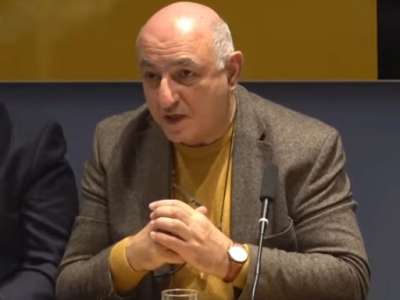
Our initiative is one month old, and it is very important to understand what has changed during this period. Boris Navasardyan, a member of Armenia’s civil society group and honorary president of the Yerevan Press Club, told this to a press conference Monday after recently returning from the Azerbaijani capital, Baku, within the framework of the Peace Bridge initiative.
“We had two main directions in terms of our work. The first: to act as communicators—that is, to convey, as much as possible, to our colleagues in Azerbaijan and to official structures the concepts that exist in our society regarding peace and overcoming the conflict and process. I assume our Azerbaijani colleagues had the same goal. And it was important for us to make sure that the mutual understanding between us also reaches the top levels. If during the meeting in Yerevan we were convinced that we understand one another, then during the visit to Baku we became convinced that what we are saying reaches its destination, regardless of what reaction it receives. There are issues where the reaction is obvious and positive, there are issues that are in progress, and perhaps there are issues where we do not reach an agreement. That is natural in such a complex process,” Navasardyan added.
“Now I will mention the directions in which we have clearly reached mutual understanding. The first is that the resource available in the expert community in both Azerbaijan and Armenia will be engaged in this normalization process. That is, there will be various formats, various events in which independent experts—including those with differing opinions—will be engaged and will have the opportunity to present their proposals and visions. The second is the media sector. For us it is necessary that the media in both Azerbaijan and Armenia contribute as much as possible to the normalization process. This does not mean they should avoid certain issues. No. All issues must be presented as intensively as possible. But it is important that there is no distortion of facts, because that sends unhealthy messages to the entire process and only hinders it. In that regard, we naturally discussed what we can do, and it will certainly be done, and we will work actively with the media,” Navasardyan said, stressing that they will present to the public what they are doing, what they have achieved, and what they are trying to achieve.
“And one more direction that we agreed on is that this 5+5 [format] will not remain 5+5, that the format will be expanded, they will engage all people who have constructive, creative ideas, and the agenda that exists today at the official level will also be expanded with our support. We understand very well that the limited time allocated to negotiations is not enough to pay adequate attention to every issue. That is why the engagement of experts is necessary; that is why the engagement of civil society organizations is necessary. And we, as the initiators of this initiative, will contribute to this as much as possible. And I believe that in the coming months you will see very serious developments in this direction,” Boris Navasardyan concluded.
On November 21, a group of Armenian civil society members traveled to the Azerbaijani capital Baku. Back on October 22, a discussion took place in the Armenian capital Yerevan with the participation of representatives of the civil societies of Armenia and Azerbaijan. And the aforesaid was a return visit in the context of normalizing bilateral relations.