make preferable
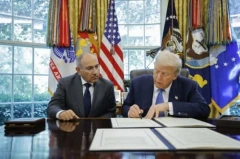
President of the European Parliament Martin Schulz met with the Turkish Minister for the EU Affairs and Chief Negotiator Egemen Bagis. The official discussed the role of Turkey in Syria, the visa regime and the prospective for Turkish membership in EU. Bagis and Schulz also commented the Armenian Genocide and the new bill adopted by the French senate.
Egemen Bagis refused to answer a question about the investigation launched by Switzerland for his remarks denying the Armenian Genocide. During the press conference in the European Parliament Bagis said: “Switzerland is not member of the EU and I will not spend one second to talk about non EU issue”.
Martin Schulz underlined the clear position of the European Parliament, which in a resolution in 2005 called on “Turkey to recognize the Armenian genocide and considers this recognition to be a prerequisite for accession to the European Union.”
“As German I know also the history of my own country and the role the imperial army of Germany played in previous time. Nevertheless, my recommendation to the Turkish authorities is today the same as it was in previous times. You should face your own history and you should allow independent inquiries about your history.
If the independent inquires come to the conclusion that it was Genocide, you should recognize it. But I think it’s first up to Turkey to solve the problem. I respect the parliamentarian autonomy and the independence of the French Parliament and I respect the law adopted in France. I know that there are a lot of people in the European Union sharing the views of the French Members of the Parliament,” Schulz added.
“Turkey is ready to establish international committee of historians and scholars and to accept their findings, as long as those findings are based on archives not only of Turkey and of Armenia, but also other countries involved, including Germany who was one of the Turkish best allies in 1915. Also UK, Russia, France, USA etc.,” stressed the Minister.
According to Bagis, politicians should not steal the role of the historians who should study history and make judgements.
“As German and especially as German president of multinational parliament, I have to live every day with our past, which is not easy past. It is a very difficult one. Demons of the past are lasting until today, every day I am confronted with the past of my country. But my country, and I am proud of this, during six decades is facing its own history; is recognizing not to be guilty – because our generation is not guilty for the crimes committed in the past. But we are responsible to avoid that it could happen once more. To be as open as possible to the past is the best way to the future,” Schulz said.