make preferable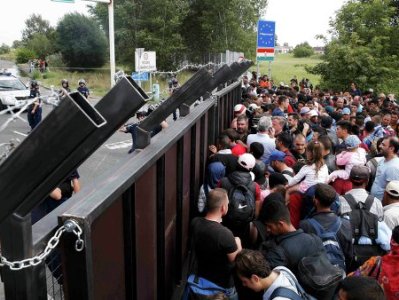
By Ani Afyan
The European Union members have been trying to deal with the refugee crisis caused by the Syrian conflict for several months. Instead of working out a common approach on migrant issues, the EU members seem to act all alone.
For example, Hungary has built a 175-kilometer wall along the border with Serbia to stop flood of migrants – the move that was slammed by international community.
In an interview with Armenian News-NEWS.am Mr. Péter Tálas, CSc, dean of the Faculty of International and European Studies at the National University of Public Service (Hungary) told about the attitude of the Hungarian society towards construction of the wall.
When the Berlin Wall fell, it seemed that this phenomenon would never happen again. In your opinion how justified was the construction of a 175-km wall between Hungary and Serbia?
When the Berlin wall fell, nobody would have thought about Europe facing such an overwhelming stream of refugees. The refugee system wasn’t established for such a vast flow of refugees, neither in Hungary, nor in Germany, so it has evidently collapsed, and the EU member states have made up their own solutions. One of these own solutions is the fence. The Hungarian Government itself did not say that this is the best solution, but in the lack of a European answer, considers is as satisfying. The Hungarian Government would have had another way too, namely, if –similarly to Greece – it lets the flow of refugees pass through the country without even making an attempt to register them. I think that this solution would miss solidarity, because it just pushes the burden of the refugee-stream to another state.
How Hungarians react to such a way of solving the problem?
According to the surveys, the majority of the Hungarian society unambiguously supports the Government’s solution. This certainly doesn’t mean that the society may not be wrong. But the Government rightly allude to the support of the society.
Hungarian Prime Minister Viktor Orban has said that the growing Muslim influx is threatening Europe's Christian roots. Do you share this point of view?
The Hungarian Prime Minister is representing the opinion of the majority of the Hungarian society. The Hungarian society is a conservative one, possessing several provincial characters and having serious reservations about foreigners. It has been like that for a long time even before the refugee crisis. Anyway, the Hungarian society doesn’t differ from other Central and Eastern European states in this perception. However, it is clear that both the Hungarian society and the political elite are subjective – that is possessing a picture of refugees determined by public and media discourse, and not based on experience.
As an expert of security policy, I personally don’t agree with this opinion of the Hungarian society and the political elite; I consider the fear of Islamization as exaggerated and totally groundless.
How would you describe/characterize the refugees? Where are they from?
The vast majority of the refugees arriving to Hungary come from Syria, Afghanistan and Kosovo. The majority of refugees from Syria and Afghanistan are authorized to be granted refugee-status as they are fleeing from war, but the ones from Kosovo, seeking better economic opportunities – are clearly not.
How did the construction of the wall affect relations between Serbia and Hungary?
Certainly, nobody on the Serbian side of the border is happy about the construction of the fence. But in Hungary people are not happy with the fact, that the transit countries delivered the refugees from border-to border, such a way escalating the flow and push of refugees. I think, everybody is aware of the fact that a common European solution is needed. A solution, where the interests of the main actors, that is the transit countries, the border countries and receiving countries, are harmonized.
What about the moral side of the situation and the criticism by the international community?
Nobody argues that the refugees, on the basis of international law and moral expectations, are not entitled to the right of asylum. The problem is rather expressed by the question, which is asked by many in Europe, not only by the Hungarian Government, whether the European refugee system was able to meet the expectations even under the pressure of the present inflow of refugees. At the moment, it appears to be operable only in case Europe fundamentally transforms its asylum system, and considers the refugee crisis as a strategic challenge, which must be managed as a priority matter in the following decades. If this comes true, all the countries, that nowadays feel lack of international support they need, will approach the problem in a different way.