make preferable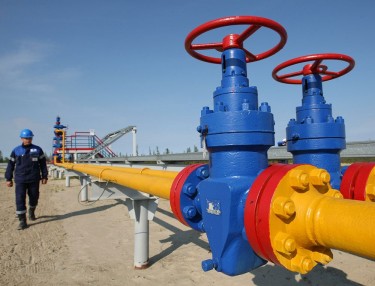
European leaders visiting Israel expressed hope that natural gas supplies from the eastern Mediterranean can help reduce dependence on Russia, AP reported.
Israel has become a gas exporter in recent years after major offshore discoveries and has signed an ambitious agreement with Greece and Cyprus to build a common pipeline.
“On the energy front, we will work together in using gas resources of the eastern Mediterranean and to develop renewable energy," Italian Prime Minister Mario Draghi said at a joint press conference with his Israeli counterpart, Naftali Bennett.
“We want to reduce our dependence on Russian gas and accelerate energy transition toward the climate objectives we’ve given ourselves,” he said.
Bennett noted that Israel is working to make natural gas available to Europe. The leaders also discussed the supply of natural gas to Europe via Egypt.
European Commission head Ursula von der Leyen, who is also in Israel this week, reiterated Europe's willingness to reject Russian gas, saying Israel could help. “We are now exploring ways to step up energy cooperation with Israel,” von der Leyen said.
In January, the European Union allocated 657 million euros to build a 2,000-megawatt submarine electric cable that would connect the power systems of Israel, Cyprus and Greece. Von der Leyen said it will be the deepest and longest cable ever built.
In 2020, Greece, Israel and Cyprus signed an agreement to build an underwater pipeline to transport gas from new offshore fields in the southeastern Mediterranean to continental Europe.
The proposed project, with an estimated budget of $6 billion, is expected to meet about 10 percent of the European Union's natural gas needs. But it is fraught with political and logistical difficulties.
At the time, Israeli officials said it would take up to seven years to build the EastMed pipeline, advertising its advantages of being less vulnerable to sabotage and not crossing many national borders.
Construction of the pipeline has not yet begun, and the EU is still conducting preliminary assessments and cost estimates. In April, a U.S. spokesman said it was too expensive, not economically feasible, and too long.
Israel has two major gas fields off the coast with combined natural gas reserves estimated at 690 billion cubic meters and continues to explore new fields.