make preferable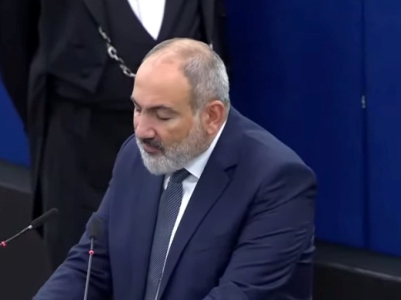
During his address Tuesday at the plenary session of the European Parliament in Strasbourg, France, Armenian Prime Minister Nikol Pashinyan reflected also on the principle of peace and normalization of relations between Armenia and Azerbaijan as expressed in the Granada Declaration. He quoted that passage from the aforesaid declaration.
‘"They stressed the urgent need to work towards border delimitation based on the most recent USSR General Staff maps that have been provided to the sides, which should also be a basis for distancing of forces, and for finalizing the peace treaty and addressing all humanitarian issues.’ End of quote.
“This principle was expressed by European Council President Charles Michel in his statement following the tripartite meeting held in Brussels on July 15 with the participation of the President of the European Council, the President of Azerbaijan and myself. I quote: ‘Both leaders (It’s again about the Azerbaijani president and myself) reconfirmed their unequivocal commitment to the 1991 Almaty Declaration as a political framework for the delimitation.’ End of quote.
“This same principle was recorded based on the results of the quadrilateral meeting in Prague on October 6, 2022 as follows. I quote: ‘Armenia and Azerbaijan confirmed their commitment to the UN Charter and 1991 Alma-Ata Declaration, through which both sides recognize each other's territorial integrity and sovereignty. They confirmed that this will form the basis for the work of the commissions on delimitation.’ End of quote.
“You should know the following additional information about this principle. The Almaty Declaration was signed by the 12 republics of the Soviet Union on December 21, 1991. That declaration made the following two important records in the context of the issue being discussed.
“1) The Soviet Union ceases to exist.
“2) The republics recognize each other's territorial integrity, sovereignty, the inviolability of existing, that is, administrative borders, and therefore the existing administrative borders between the Soviet Republics become state borders.
“Azerbaijan declares that there is no border between Armenia and Azerbaijan, which contradicts the Almaty declaration and the above-mentioned agreements. Azerbaijan also maintains ambiguities in accepting the latest maps of the Soviet Union as a basis for delimitation, which also gives some experts a reason to assume that Azerbaijan is preparing grounds for making territorial claims against Armenia and initiating a new military aggression,” Pashinyan said.
“The next principle of peace and normalization of relations between Armenia and Azerbaijan is expressed in the Granada Declaration as follows. I quote: ‘They called for greater regional cooperation and for the re-opening of all borders, including the border between Armenia and Türkiye, as well as for the opening of regional connectivity links based on full respect of countries’ sovereignty and jurisdiction, as well as on the principles of equality and reciprocity.’ End of quote.
“This principle was expressed by European Council President Charles Michel in his statement following the tripartite meeting held in Brussels on July 15 this year with the participation of the President of the European Council, the President of Azerbaijan and myself. I quote: We (that is, the President of the European Council, the President of Azerbaijan and I) discussed modalities of future transport arrangements which will respect the principles of sovereignty, jurisdiction and reciprocity.’ End of quote.
“You need to know the following additional information about this principle. Azerbaijan continuously insists that Armenia is obliged to give Azerbaijan a corridor through its own territory. In everyday international parlance that you are familiar with, the word corridor simply means interstate roads. But there is a peculiarity in the case of our region. In the tripartite statement of November 9, 2020, the word ‘corridor’ is used only for the Lachin Corridor, which was supposed to connect Nagorno-Karabakh and Armenia. The peculiarity is that according to that document, the Lachin Corridor is not just a road, but also a 5-kilometer-wide territory, which should have been outside the control of Azerbaijan, under the control of peacekeepers. Therefore, in this context, the word corridor has the meaning of an extraterritorial layer.
“The Republic of Armenia has never, anywhere, agreed to any limitation of its sovereignty and jurisdiction over any of its territories, has not made such a promise. Therefore, what does the principle quoted above mean?
“It means one simple thing. On the basis of their sovereignty and jurisdiction, Armenia and Azerbaijan should open their roads for each other without the above-mentioned corridor logic. At the checkpoints of those roads, border and other relevant control services should operate, based on the jurisdiction, sovereignty, and legislation of the countries. This should be done based on the principle of reciprocity and equality, and we are ready to go for such solutions, we are ready to restore the Meghri railway, which will connect not only Azerbaijan and Armenia, but also the southern regions of Armenia with the northwestern regions, the southwestern regions of Azerbaijan with the Autonomous Republic of Nakhichevan, with its further continuation it will link Armenia with Turkey, Azerbaijan with Turkey, Georgia, Azerbaijan, Armenia with the Islamic Republic of Iran, East with the West, stretching from the Caspian Sea to the Mediterranean, North with South, from the Gulf to the Black Sea. In Armenia, we call this project the Armenian Crossroads. But I think it's time to further regionalize this project, rebrand it, and call it Crossroads of Peace, and this name is equally important and acceptable for us. In the same logic, we are ready for the opening of roads as well. The Republic of Armenia is ready to ensure the safety of cargo, vehicles, people, pipelines, electric lines in its territory, because the Crossroads of Peace implies the passage of pipelines and power lines as well.
“This kind of solutions are also very important for the Republic of Armenia, because our country has been under blockade by Azerbaijan and Turkey for 30 years.
“As you can see, there is no reason to accuse Armenia of obstructing the opening of transport communications in the region, but there are analyzes that official Baku is manipulating the narrative of corridor to provoke a new war in the region, to occupy new territories of Armenia, or to keep Armenia under blockade. This should not be allowed.
“As you saw, all the principles mentioned above were developed and agreed upon with the participation of the President of the European Council and the President of Azerbaijan, and we are ready to implement these agreements,” the Armenian PM said.