make preferable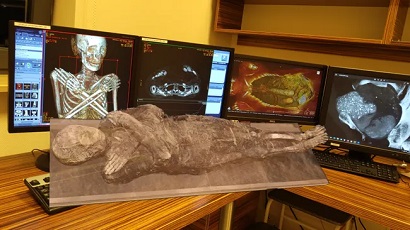
An ancient Egyptian woman thought to have been pregnant and dying of cancer was actually just embalmed with a technique that mimicked these diagnoses, researchers have concluded, settling a four-year scientific debate, Live Science reports.
Nicknamed the "Mysterious Lady," the first-century-B.C. mummy was found in the Egyptian city of Luxor (ancient Thebes) but was brought to the University of Warsaw in Poland in 1826. The mummy was not scientifically studied for over a century.
In 2021, experts with the Warsaw Mummy Project concluded that, contrary to their assumption that the mummy was a male priest based on the sarcophagus, it was actually the remains of a woman in her 20s who was 6.5 to 7.5 months pregnant.
In the first published study of the mummy, researchers used X-ray imaging and CT scans to identify several bundles of mummified organs in her abdomen. They also suggested that a poorly preserved fetus, around 28 weeks in gestational age, could be seen on the scans.
In a second study, the research team proposed that the reason no fetal bones could be clearly identified was that the mother's uterus lacked oxygen and had become acidic over time, essentially "pickling" the fetus. And finally, the team suggested that they had found evidence of potentially fatal nasopharyngeal cancer in the mummy's skull.
These interpretations were controversial, however.
To settle the debate, a team of 14 researchers with varied expertise led by archaeologist Kamila Braulinska of the University of Warsaw studied the Mysterious Lady and published their findings in the journal Archaeological and Anthropological Sciences.
Every expert who reanalyzed the CT scans concluded that there was no fetus and that the material assumed to be a fetus was actually part of the embalming process. Further, the suggestion that the fetus' skeleton and soft tissue did not show up on the scans because the body was "pickled" is impossible, the researchers noted in the study, because acids within the human body are insufficient to dissolve bone, especially after a body is embalmed.