make preferable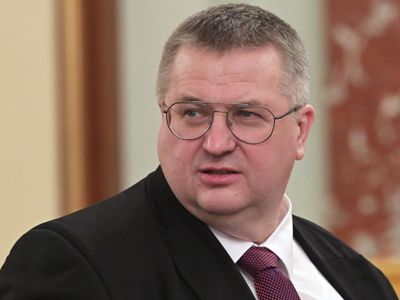
Representatives of Russia, Azerbaijan, and Iran met in Azerbaijan’s capital, Baku, to discuss infrastructure cooperation and strengthening transport connectivity in the region. According to the Russian government’s website, the Russian delegation at these talks was led by Deputy Prime Minister Alexey Overchuk.
During the meeting, Overchuk emphasized the importance of developing joint solutions to create a convenient and seamless environment for carriers, exporters, and importers within the framework of developing the western route of the North–South international transport corridor.
According to the Russian Federal Customs Service, in the first half of 2025, a total of 176,761 international transport vehicles crossed the Russian-Azerbaijani state border, a 10 percent increase compared to the same period last year. Cargo turnover rose by 13 percent to reach 6.8 million tons.
“We have taken measures at the road checkpoints on the Russian-Azerbaijani state border, which have quintupled their capacity, from 400 to 1,900 trucks per day,” Overchuk added.
And after the reconstruction of three motorway checkpoints, total freight capacity on the Russian side will reach 3,000 vehicles per day.
At the end of last year, an intergovernmental agreement with Azerbaijan was signed to develop transit traffic along the North-South international transport corridor.
Under Russia’s 2023 agreement with Iran, the latter continues work on constructing the Rasht-Astara railway section. In May 2025, the Russian side began preliminary surveys, reconnaissance, and work on creating a geodetic control network.
“To enhance the attractiveness of the western route of the North-South international transport corridor, it is important for us to develop harmonized transport infrastructure between Russia, Azerbaijan, and Iran, and create equal conditions for all honest carriers crossing the state border,” Overchuk stated.
The Russian deputy premier noted that this work is driven by growing trade and economic ties between Russia, Azerbaijan, and Iran. Trade between the countries is showing stable growth. Russian imports from Azerbaijan increased by 9.5 percent to $742.4 million in the first seven months of 2025. Trade with Iran grew by 13.3 percent in 2024, and by 11.8 percent in the first seven months of 2025, reaching $2.7 billion.
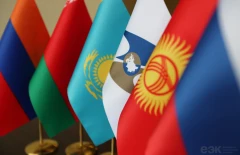
Also, the free trade agreement between the EAEU and Iran has provided a special boost to trade relations. The agreement came into force on May 15, 2025.
“If we look at the statistics from May to July 2025—that is, since the start of the free-trade zone with the EAEU, we have already seen a 35 percent increase in trade turnover,” Overchuk emphasized, noting that the first meeting of the joint committee on implementing the free trade agreement took place on September 24, after which the 2025-2028 program for trade and economic cooperation between the EAEU and Iran was adopted.
Alexey Overchuk stated that the strategic goal of the joint infrastructure work is to ensure seamless logistics from the Barents and Baltic seas to the Persian Gulf, creating the best competitive conditions for the producers, exporters, and importers of Russia, Azerbaijan, and Iran.
“This work provides our economies with additional opportunities for expansion, creates new jobs, increases revenues, and improves people’s lives,” the Russian deputy PM said.