Preferred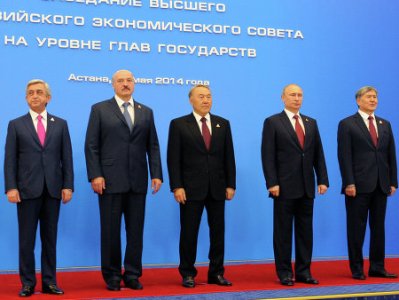
Armenian News – NEWS.am presents the abridged version of the article by observer David Floyd, published on the website of Nasdaq stock market:
“Given the eurozone’s many woes, it’s hard to imagine why another region would want to embark on a unified currency project. But the world is full of surprises.
On May 29, at a summit in Kazakhstan, Russian Prime Minister and former President Dmitry Medvedev announced that the Eurasian Economic Union (EEU) would “consider the possibility and conditions of launching a monetary union in the long term.”
Of the EEU member states, only Russia has expressed any enthusiasm for a single EEU currency. As with so much of the communication coming from the Kremlin, the reasoning is a bizarre inversion of the truth. Officials have cited the US economy’s potential collapse—perhaps they meant the Russian economy?—and proposed banning euros and dollars in EEU members’ transactions. In reality Russia’s central bank has gutted its foreign exchange reserves in order to prop up the ruble and now hopes to replenish them to pre-crisis levels.
Meanwhile Kazakhstan is vocally defending its sovereignty, Belarusian president Alexander Lukashenko has said the single currency should be the “last [issue] on the agenda” and Armenia is probably still pining for EU membership. None of these countries seems to want a common currency.
But when push comes to shove, Russia does not concern itself with what other countries want. If the Kremlin sees a unified currency as being in its interest, it will use energy, remittances and propaganda as leverage to force its neighbors’ hands.
So long as the Kremlin communicates in conspiracy theories, it is difficult to assess how important the single currency really is to Russia’s leaders.
In October 2014, Pravda reported that the EEU single currency would likely be called the altyn, a name that has been applied to different currencies going back to the 15th century. The report gave a timeframe for the altyn’s introduction: 2025, all things being equal, but perhaps as soon as 2017 due to the impact of sanctions.
Judging by the relative sizes of the economies involved, the altyn would in essence be the ruble. Using the World Bank’s 2013 GDP figures—keeping in mind that Russia’s economy is set to shrink this year—Russia makes up 87% of the proposed altyn-zone.
By contrast, the eurozone’s two largest economies, France and Germany, together made up just under 50% of the whole. All told, the eurozone’s collective GDP of $13.2 trillion is around 5.5 times greater than the proposed altyn-zone’s $2.4 trillion.
The altyn would be inextricably tied to oil prices, which are unlikely to recover to pre-crash levels in the next few years.
Russia’s partners in the newly formed EEU are nervous about Putin’s ambitions and, at least when it comes to their domestic audiences, wish to be seen opposing the single currency. On the other hand, Russia has extensive leverage over these governments, whose economies are tied to Russian gas and remittances sent by migrants working in Russian cities. Whether the altyn becomes a reality mainly depends on how committed the Kremlin is to the idea. As for its potential to replace the dollar or euro as a reserve currency, don’t count on it—or anything else RT says.”