make preferable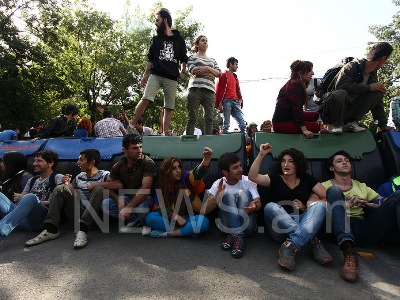
Armenian News – NEWS.am presents the abridged version of the article published on the website of the private investigative-analytical company Stratfor:
“Protests in Armenia's capital, Yerevan, over the government's plan to raise electricity prices 16 percent are now in their third week. Though the government has made some concessions, demonstrators continue to take to the streets daily. Public protests are frequent in Armenia and so far do not pose a significant threat to the government. More important, in spite of widespread comparisons to Ukraine's Euromaidan movement, Armenia's electricity protests do not threaten Russian interests. The demonstrations, however, might grow if clashes between protesters and security forces turn violent.
Armenia has a higher tolerance for public demonstrations than other states in the former Soviet Union, making such tolerance a key factor in assessing the current protest movement. Still, they typically do not pose a major threat to the government or challenge the strong position of Armenian President Serzh Sarkisian, who has ruled the country since 2008.
However, in the context of the crisis in Ukraine that began with the February 2014 Euromaidan protests, the media and public officials now pay greater attention to large demonstrations in the former Soviet Union. Shortly after the Yerevan demonstrations began, the media began to speculate as to whether this might be the "Armenian Maidan." Armenia's status as a Russian ally has only fueled these rumors.
But to this point, the protests have had little to no geopolitical motivation or evidence of external support. Because Russian utility firm Inter RAO UES owns Armenia's electricity grid, some see the protests as focused on Moscow's influence. Demonstrators, however, have been clear that their focus is on reversing the government's decision to raise electricity prices and not on broader strategic issues. Even if demonstrations were to take on a broader message or call for Armenia to shift away from Russia, there is little cultural and political support for the country to move toward the West in the same way Ukraine did prior to the Euromaidan protests. Yanukovich's decision to back out of the EU Association and Free Trade Agreement sparked the Euromaidan protests. Armenia's president, by contrast, made the same decision with relatively little public backlash.
Currently the protests have little significance on the strategic level. The situation could change if demonstrators can sustain the movement or if they clash with police. So far, the government has shown considerable restraint since the original crackdown on June 23, but any change in tactics could enflame the protests and escalate the situation.
Since the Euromaidan movement, Russia has become sensitive to the possibility of escalation. Perhaps to prevent a replay, Moscow has engaged in a flurry of activities to draw closer to Yerevan, such as granting $200 million in financing for Armenia to purchase Russian arms and letting Armenian courts try a Russian soldier accused of murdering an Armenian family, a case that had sparked protests earlier in 2015. But while Moscow is worried, the Armenian government appears willing to wait and see or even to concede on the electricity hike issue to avoid the unstable and unpredictable environment that would accompany the use of force against the protests.”