make preferable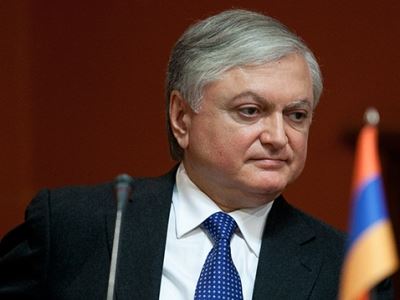
The problems that our region, the South Caucasus, is facing may seem less visible to many observers from various parts of the world, but this should not mislead anyone. This region has for a long time been a place of geopolitical rivalry, marked by lingering wounds, Armenian Foreign Minister Edward Nalbandian said during his speech at the Chatham House.
“The resolution of the conflict between Azerbaijan and Nagorno-Karabakh is one of the main priorities of our foreign policy. A couple of months ago there was an excellent opportunity here at the Chatham House to get first hand insights on this issue directly from the President of Nagorno-Karabakh. Needless to say, that the views and approaches of Nagorno-Karabakh are essential in the conflict resolution,” he added.
Armenia continues to make efforts together with the mediators – the OSCE Minsk Group Co-Chair countries - United States, Russia and France, to reach an exclusively peaceful solution to this conflict.
The Minister noted that the Co-Chairs have a common approach on the fundamental principles of the Nagorno-Karabakh conflict settlement which is a rare example in the current turmoil in the international relations.
“We forthrightly stand by the position of the international community that negotiations, compromises and preparation of our societies to peace have no alternative for the conflict resolution,” Minister Nalbandian said.
According to him, the reason that a breakthrough in the peace talks has not been achieved is the rejection of Azerbaijan of the proposals of the Co-Chair countries.
“Continuous cease-fire violations by Baku along the border with Armenia and on the line of contact with Nagorno-Karabakh once again prove that Azerbaijan continues to jeopardize the conflict resolution process, the efforts of the OSCE Minsk Group Co-Chairs aimed at the peaceful settlement of the issue and undermining the upcoming meetings initiated by the mediators.
During the Baku European Games this June Azerbaijan exercised restraint on the ground, since they needed a calm period. The situation drastically changed immediately after the Games when Azerbaijan intensified the ceasefire violations. In fact by its actions Azerbaijan once again clearly identified, which side is responsible for the escalation of the situation. Baku didn’t even bother to conceal its militaristic attitude,” the Minister said.
He emphasized that Azerbaijan continues heavy military buildup, by increasing its military budget nearly 30 times in a decade. As long as Azerbaijan's bellicose aspirations are not curtailed, there will be no real progress in the peace talks.
“The implementation of the agreement on the mechanism to investigate the incidents on the Line of Contact, together with other proposals on confidence and security building measures made by the Co-Chairs could be an important tool for prevention of such incidents and creation of the environment conducive for the peace talks. Azerbaijan continuously rejects numerous proposals of Co-Chairs on consolidation of the cease-fire, withdrawal of snipers and on other confidence building measures while Armenia and Nagorno-Karabakh have welcomed those proposals. It is obvious there is no military or political goal that Nagorno-Karabakh or Armenia might seek via the escalation of the situation.
While the international community speaks about the necessity of preparing the societies for peace Azerbaijan continues on an official level the policy of injection of hatred against Armenians. The similarities between the destruction of thousands of Armenian Medieval cross stones in Nakhichevan by the Azerbaijani army and the devastation of 2000-year-old monuments in the historic Palmyra bear a striking resemblance. Deliberate destruction of monuments, be that in Syria or Nakhichevan, should be considered as a crime against civilization.
The road from authoritarianism to totalitarianism and despotism is interlinked to the escalation of the tensions through which the Azerbaijani leadership is attempting to mislead and distract the attention of the international community from the outrageous human rights violations in Azerbaijan. The cornerstone of authoritarianism is hatred. Propaganda of enmity towards a neighbor is one of the favorite methods of such regimes to strengthen loyalty inside their countries by punishing representatives of media, civil society and intelligentsia, who dare to speak up against the regime and stand for peace and reconciliation. Not surprisingly many of them in Azerbaijan have been put behind the bars with allegations on serving the Armenian interests. The xenophobic hatred against Armenians has become the dominating rhetoric of Azerbaijan and state-supported policy for decades. While stating that Armenia is situated on native Azerbaijani lands, President of that country declared that Armenians all over the world are the “Number 1 enemy” of Azerbaijan.”