make preferable
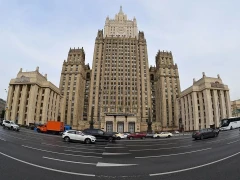
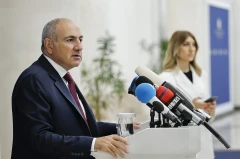
October 8-11, 2009 Harvard Black Sea Security Program (U.S.) had its annual regional workshop in Moscow for the first time. According to the participants, this fact reflects the tentative “reloading” in Russian-U.S. relations. NEWS.am quotes the scientific report of Commandant of the Institute for National Strategic Studies, MOD, Republic of Armenia Major General Hayk S. Kotanjyan, Doctor of Political Sciences (Russian Federation), Counterterrorism Fellow (National Defense University, USA), Fellow Member of the Russian Academy of Military Sciences.
Dear General Oelstrom and Doctor Konoplyov,
Dear Moscow Hosts of the Forum,
Dear Colleagues,
It’s my pleasure to successfully pass the baton of our authoritative Harvard Workshop from Yerevan to Moscow and welcome its honorable organizers and participants.
It is not only symbolic but, also, important in a political essence. It is difficult to conceive the formation of contemporary international security architecture without establishing an efficient dialogue and cooperation between Moscow and Washington. Recent developments in Russian-American relations open up new possibilities to form — first and foremost- a homogenous global, European security environment. It is important that the Heads of both states addressing the world community consider the principle which excludes ensuring the security of the entity at the expense of others as a basis to form a contemporary international security system. Now, the “peace paradigm” and not the “war paradigm” is proposed to deem as a basis for new international security architecture.
The recent G-20 Pittsburgh Summit, the 64th Session of the UN General Assembly, the NATO Jubilee Summit in Strasbourg, negotiations of the US and Russian Presidents in the Moscow in July, the G-8 L'Aquila Summit have significantly renovated views of outlines of global and regional security frameworks being shaped under the conditions of the systemic world financial-economic crisis.
The South Caucasus region is directly engaged in the sphere of strategic interests of Russia, the U.S., EU, OSCE, NATO and CSTO. Consequently it sensitively responds to changes in the relationships between these power centers. After taking the office, President Mr. Barack Obama started to attach greater importance to “smart power” in the field of international relations. This creates prerequisites for the formation of a more balanced regional security system in the South Caucasus, thus involving in it regional system-forming elements and contacts.
Within the framework of the EU “Eastern Partnership” new program consultations on regional cooperation perspectives contribute to the pursuit of optimal regional security architecture in the South Caucasus. New possibilities of enhancing regional security were opened up by the initiative of the Armenian President by launching – without preconditions – the Armenian-Turkish dialogue regarding possibilities of establishing diplomatic relations between Armenia and Turkey, and putting an end to Armenia’s blockade by Turkey. Submitting the draft protocols on normalizing Turkish-Armenian relations for a broad public debate in Armenia, Turkey, with the Armenian Diaspora, is targeted at strengthening confidence among peoples, and facilitating peace and stability in the South Caucasus.
Armenia’s balanced participation in different international security organizations and its foreign policy initiatives are targeted at increasing the potential of international efforts to support stability in the South Caucasus. Examples of such efforts include: the UN, OSCE (Minsk Group), CSTO (Collective Forces of Operative Reaction), NATO (“Partnership for Peace” program), EU (“Eastern Partnership” integration program), various fora of the Organization of the Black Sea Economic Cooperation, and political-diplomatic efforts of Russia, America, France and other regional actors.
In the context of ensuring security in the South Caucasus, special attention is paid to the signing of the Maiendorf Declaration on Karabakh conflict settlement by the Heads of State of Armenia, Azerbaijan and Russia in November, 2008 (on the initiative of the Russian President), and the joint statement of the Presidents of the OSCE Minsk Group Co-chair countries in July, 2009, regarding the Madrid Principles of Karabakh conflict settlement (in which mediator states express their support for the Armenian and Azerbaijani leaders in the course of peaceful resolution of the Karabakh problem).
An encouraging factor for the non-resumption of war in Karabakh, fraught with catastrophic undermining of regional security, is the consent of the conflicting parties to the proposal of the Minsk Group Co-chairs to accept the three fundamental principles of the UN Charter –"non-use of force", “territorial integrity” and “peoples’ free self-determination” as basic principles for the settlement and resolution of the Karabakh conflict.
The uninterrupted dialogue between the Armenian and Azerbaijani Heads of States (with the support of Russian, US and French Presidents), as well as with the counseling of the Minsk Group Co-chairs has undoubtedly a positive influence on the peacekeeping process in the South Caucasus.
I would like to put a special emphasis on the necessity of reaching a mutually acceptable reconciliation agreement based on a mutual quest for peace and not “threatening by war”. Evidently, the Madrid Principles system has positive facets. It reflects the above-mentioned basic principles proclaimed by the Minsk Group Co-chairs. In these terms, it is difficult to overestimate the contribution of Russia, the U.S. and France to the advancement of the Minsk process through peaceful means.
At the same time, pretensions of experts, including our respectful American colleagues, regarding some foreign policy peculiarities of the President George Bush Administration should be considered . In a broad sense, the matter concerns the dominant position of the military aspect within the security thinking of the Bush Administration. i.e. — the preference of hard security tools in resolving foreign policy problems, (including regional international conflicts regarding the right of free self-determination, which are identified as national-liberation and anti-colonial ones in compliance with the 1st Protocol Additional to the 1949 Geneva Conventions).
Unfortunately, these pretensions may also apply to some approaches towards the Karabakh conflict resolution. In the case of the Madrid Principles, the above-mentioned methodological misconceptions of the Bush Administration are reflected in the fact that the “war paradigm”, and not the “peace paradigm”, underlies the Karabakh conflict settlement and resolution. This approach retains the pursuit of peaceful conflict resolution in a counterproductive format of “war resumption threat”. Such a peculiar methodology can largely explain the fact that the Azerbaijani party publicly demonstrates as a “basic compromise” “its readiness not to resume hostilities”. In other words, an approach to the Karabakh conflict resolution based on the “war paradigm” does not contain a mechanism of stimulating Azerbaijan to reciprocal, equivalent, compromises targeted at the realistic advancement of lasting peace. This may account for multiple excesses of offensive arms ceilings by the Azerbaijani party, (set by the CFE Treaty), and for the open propaganda on the intensive preparation of the Azerbaijani Armed Forces for war resumption in intra – and international rostra.
It is appropriate to recall President Mr. Heydar Aliyev’s more realistic position at the spring 1994 negotiations with the Armenian and Nagorno Karabakh parties, when the war unleashed by Azerbaijani President Mr. Ayaz Mutalibov and the Leader of the People’s Front Abulfaz Elchibey was ended by a truce brokered by Russia. According to the words of direct participants of the May, 1994 negotiations this position includes the readiness of Azerbaijan to recognize the existence of the Nagorno Karabakh Republic as established by a referendum and in compliance with the 1990 USSR “perestroika” legislation. Thus, the legitimacy and appropriateness of the secession of Nagorno Karabakh from Azerbaijan, together with Lachin and Kelbajar districts (connecting the Nagorno Karabakh Republic with the Republic of Armenia) were recognized. As a form of mutual compromise, the President Mr. Heydar Aliyev was conducting negotiations on the possibility of returning the rest of the territories from the security zone (created by self-defense forces of the Nagorno Karabakh Republic as a result of repelling aggression unleashed against the new legitimate Armenian state by the former leadership of Azerbaijan). This was the essence of the 1994 consultations on mutual compromises regarding the comprehensive resolution of the Karabakh conflict and establishment of durable peace between the Armenian and Azerbaijani peoples.
Therefore 15 years ago the authorities of Armenia, Azerbaijan and Nagorno Karabakh according to the basis of the “peace paradigm” perceived the realities created in East Transcaucasia in accordance with the USSR Law “On procedure of settling issues related to withdrawal of a Soviet Republic from the USSR” and norms of international law – on the threshold of the USSR disintegration and the results of war waged by President Mr. Mutalibov against legally self-determined Karabakh.
President Barack Obama’s team distances itself from the security strategy of the George Bush Administration focused on “hard security” with prevalence of the military-based approach. Proclamation of “smart power” by the new US administration as a system-forming and dominating parameter of security policy creates premises for reviewing the methodological basis of the Karabakh settlement process. Under these new conditions reorientation of the Madrid Principles elaborated considerably by the efforts of the former US administration from the “war paradigm” to the “peace paradigm” can stimulate all the three conflict parties on equivalent compromises for achieving lasting peace in the South Caucasus.
In the context of establishing an atmosphere of mutual understanding and trust in the region, the uninterrupted dialogue between the Heads of Armenia and Azerbaijan Mr. Serzh Sargsyan and Mr. Ilham Aliyev is a great support for resolution of the Karabakh conflict resolution. Particularly in that very context, it is evident that the powers trying to resolve national-liberation type Karabakh conflict through colonial type war should learn sober lessons from tragic results of the last year's war in Georgia. These lessons learned prove the following: the lasting peace in Eastern Transcaucasia could be reached by recognizing of legality of the Nagorno-Karabakh Republic by Azerbaijan and through returning by Armenia to Azerbaijan the territories of the Nagorno-Karabakh Republic`s Security Zone (excluding the Lachin and Kelbajar districts bridging Karabakh via Armenia with the international world community).
Ongoing productive dialogue between the American and Russian Presidents Mr. Barack Obama and Mr. Dmitry Medvedev, has created a unique possibility for the South Caucasus countries to contribute to the formation of balanced regional security based on the “peace paradigm” and the principle of “smart power”. It creates premises to achieve guaranteed, lasting peace based on equivalent mutual compromises. It also functions to support the launching of programs of regional and trans-regional cooperation.
In these terms joint quest for the peaceful, compromise-based resolution of the Karabakh problem which adheres to the three above-mentioned fundamental principles of international law will be of strategic caliber, furthermore it can become a basis for ensuring stability and security in the South Caucasus, — and beyond.