Preferred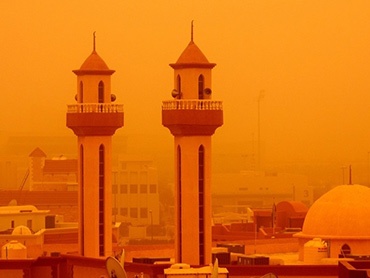
A part of the Middle East and the North Africa by 2050 will be unsuitable for human life. The change of climate will lead to a mass migration of the population from those territories, concludes research done by scientists from Germany and Cyprus, as Lenta reports with a reference to the Max Planck Society (Germany).
At the end of April 2016, 175 states signed an agreement that stipulates that the greenhouse gas emissions will reduce. As the scientists believe, it can slow down a pace of global warming and prevent the temperature from increasing more than two degrees Celsius by 2050.
Nevertheless, research pinpoints that those steps are not enough to prevent disasters in the Middle East and North Africa . By 2050, the temperature at summer nights will reach 46 degrees Celsius , the average summer temperature at night will be no less than 30 degrees (according to an optimistic forecast).
There are expected to be extremely hot days five times more in that region than they are today ( 80 instead of 16 ) . The temperature of the hottest days in summer will reach 50 degrees, and the number of days will make 118-200 (depending on the climate model ) by the end of the century. The conditions for life will deteriorate due to air pollution as well ( strong winds will bring dust from the deserts ).
There are now 500 million people living in the Middle East and North Africa. Compared to 1970 the number of hot days in the region doubled . Since the beginning of the XX century air pollution in Saudi Arabia , Iraq, and Syria has increased on average by 70 % . This is due to the increase of drought duration and frequency of sandstorms.