make preferable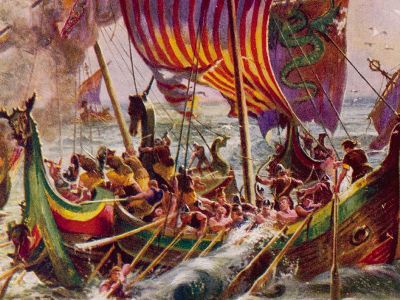
People with Scandinavian ancestry were in Britain long before the Anglo-Saxons or the Vikings turned up, researchers have found after studying the genetics of an ancient Roman buried in York, reports The Guardian.
The arrival of the Anglo-Saxons brought an influx of Scandinavians to ancient Britain in the fifth century, with the first major Viking raid—which targeted the monastery at Lindisfarne—occurring in AD793.
However, researchers studying a man thought to have been Roman soldier—or perhaps even a gladiator—who lived between the second and fourth century have found that 25% of his ancestry came from Scandinavia.
“The ancestry that we thought would come in [with] Anglo-Saxons maybe in some parts was already there,” said Dr Leo Speidel, first author of the study and a group leader at Riken, a national scientific research institute in Japan.
The discovery is part of a large-scale study that has taken a new approach to analyzing ancient DNA, shedding fresh light on migrations across Europe in the first millennium.
Writing in the journal Nature, Speidel and colleagues report how they developed a new approach to tackle the issue.
Instead of considering all of the genetic differences between populations, the new method focuses on relatively recent mutations within genomes—arising, for example, in the past 30,000 years or so—allowing the relationships between genetically similar populations to be explored in greater detail.
However, the team was surprised to find evidence of a later migration in the opposite direction.
“We found this previously unknown migration into Scandinavia [about] AD500 to AD800 that transforms completely the genetic makeup in the Viking age in Scandinavia,” said Speidel.
The study also explores the Viking expansion from Scandinavia, with highlights including the discovery that many individuals found in two late Viking-age mass graves in Britain had a genetic makeup typical for Viking-age southern Scandinavia – suggesting they could have been Vikings who met a sticky end.
While the new approach can challenge, support or add detail to the historical record—and even produce revelations—the researchers say it also offers the chance to explore the lives and movements of those overlooked in written history, a source often more biased than human remains.
“The idea is that we can now investigate history with ancient DNA,” said Speidel.