make preferable
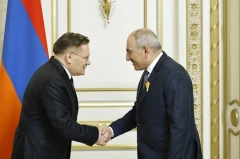
Armenian-Turkish “football diplomacy” reached its logical end yesterday. Armenian President accepted his Turkish counterpart Abdullah Gul’s invitation and visited Bursa. The Presidents held tête-a-tête talks followed by a meeting with the participation of Foreign Ministers Edward Nalbandian and Ahmet Davutoglu. The meetings were followed by an Armenia-turkey football match as part of the 2010 World Cup qualifying round. The Armenian team lost the game with a score 2-0.
In the context of the World Cup prospects, the match was of no importance to either the Turkish or the Armenian team. Both the teams lost their chances to play at the Mundial in South Africa. As regard the political results, RA Foreign Minister Edward Nalbandian spoke about them late last night after the match. The Armenian FM pointed out that the October 14 meeting proved to be an excellent occasion for the two Presidents to discuss the way they have passed, as well as the step that are to follow the signing of the Armenian-Turkish protocols in Zurich on October 10. “Steps to implement the agreements,” Nalbandian said. “It will open the door that has for a long time divided our nations and lay the foundations for further bilateral relations,” the Minister said.
Thus, after settling their “football relations”, Armenia and Turkey are halfway to achieving the results of their political dialogue. The Zurich Protocols need ratifying by the two Parliaments. President Abdullah Gul promised yesterday the documents will be submitted to the Turkish Parliament on October 21.
Head of the principal faction in the RA Parliament Galust Sahakyan (Republican Party of Armenia, RPA), stated earlier that Yerevan will ratify the protocols only after the Turkish Parliament has voted for them. Quite a number of political forces in both countries, as well as some circles in the Armenian Diaspora and Azerbaijan, are against “open doors” between Armenia and Turkey. As regards Azerbaijan, it will do its best to torpedo the process, viewing it as a threat to its regional positions and negotiation strategy in the Nagorno-Karabakh peace process.
“Football diplomacy” is over. Real politics comes into play.