make preferable
Germany’s heavy reliance on Russian energy could tip its economy into recession, an independent economic think tank warned on Wednesday, CNBC reported.
“The high dependence on Russian energy supplies entails a considerable risk of lower economic output and even a recession with significantly higher inflation rates,” the German Council of Economic Experts, which advises the government in Berlin, said in a report Wednesday.
German Chancellor Olaf Scholz expressed similar concerns last week in an address to the country's parliament, saying that imposing an immediate ban on energy imports from Russia “would mean plunging our country and the whole of Europe into a recession.”
In 2020, Germany imported nearly 59 percent of its natural gas from Russia, according to the European Statistical Office. Other EU countries registered even greater dependence: the Czech Republic imported 86 percent of Russian gas, and Latvia and Hungary imported more than 100 percent, meaning they bought more than their domestic needs.
Germany’s Economy Minister Robert Habeck triggered a first warning, out of three possible levels, on gas stockpiles. He urged businesses and households to reduce their energy consumption, saying “every kilowatt-hour counts.”
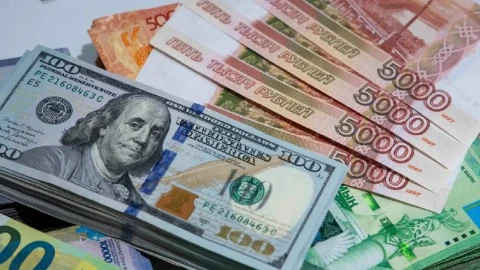
Energy dependence became even more alarming for Europe after Russian President Vladimir Putin said last week that "unfriendly" countries would have to pay for natural gas in rubles. But Western countries, including Germany, said this would be a breach of contract and urged companies to continue paying in euros or US dollars, increasing the chances of disrupting energy flows.
“Germany should immediately do everything possible to take precautions against a suspension of Russian energy supplies and quickly end its dependence on Russian energy sources,” the German Council of Economic Experts also said on Wednesday.
The institution predicts gross domestic product of 1.8 percent this year and 3.6 percent in 2023 for Germany - provided that energy supplies are not suspended.
As for inflation, its estimates point to a rate of 6.1% this year and 3.4% in 2023.